Aegis provides affordable, low power Wi-Fi sensor network solutions that make a ubiquitous sensing world come alive and a full line of controlled temperature cabinets. Laboratory, Pharmacy and Chromatography refrigerators and freezers which are designed to meet the dimensional and temperature requirements of the scientific community.

2026 Best Hood Filter for Commercial Kitchens?
Choosing the best Hood Filter for a commercial kitchen is not simply a matter of buying the thickest or cheapest option. The right choice depends on hood dimensions, cooking volume, equipment compatibility, and the airflow range specified by the hood manufacturer. Grease capture matters. So does pressure drop. A filter that captures grease effectively but restricts airflow may affect exhaust performance and comfort near the cooking line.
This guide compares common filter materials and designs, including stainless steel baffle filters and mesh options where suitable. It also considers fit, cleaning effort, durability, and replacement costs. Check the product specifications before ordering; a filter that looks right may not fit the frame or suit the system. Small details matter, such as the direction of a baffle’s channels and whether a filter can be removed safely for routine cleaning. No single model is best for every kitchen. Menu, appliance output, and daily cleaning habits can change what works in practice. That sounds obvious, but it is easy to overlook when comparing prices alone. We’ll outline what to verify, which trade-offs deserve attention, and when manufacturer guidance is more useful than a generic recommendation. Because filter performance depends on the complete exhaust setup, treat product claims as a starting point, not a guarantee. A careful choice can support cleaner operation; it cannot replace proper maintenance.
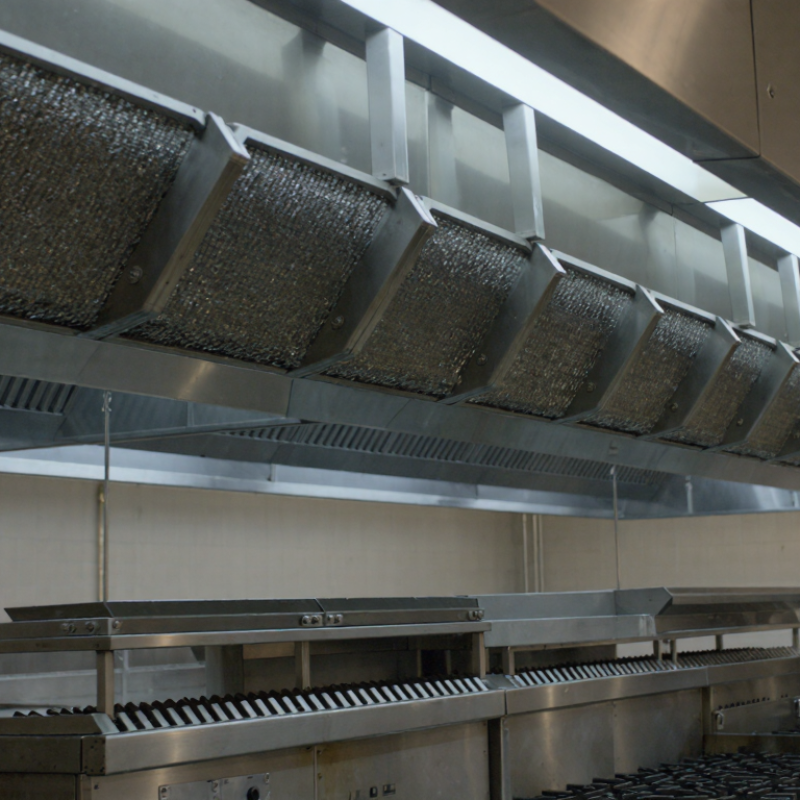
Table of Contents [Hide]
What a Commercial Kitchen Hood Filter Does
A commercial kitchen hood filter sits between the cooking line and the exhaust duct. Its main job is to capture airborne grease before it travels deeper into the ventilation system. As hot vapors rise from a fryer or grill, the filter redirects airflow through narrow channels. Grease droplets strike the metal surfaces and drain into a collection area. Small part. Important work.
This reduces grease buildup in ducts and fans, which can support safer, steadier exhaust performance. A filter does not eliminate fire risk, smoke, or cooking odors, and it cannot replace regular hood and duct cleaning. It is easy to overestimate what the filter alone can do. For a practical fit, check the hood’s specified filter size and type, then consider the kitchen’s cooking volume. Stainless steel models are often sturdy; lighter materials may suit other setups. The right choice depends on compatibility, not appearance.
Routine checks matter. Look for loose handles, bent edges, clogged channels, or grease that remains after washing. A filter can look clean at a glance and still restrict airflow. Clean it according to the equipment maker’s instructions and the kitchen’s actual workload; a busy fryer station may need attention more often than a light-use line. Even experienced staff can miss a damaged corner. That small gap deserves a closer look.
Contact Us
Phone
Toll Free: 1-800-796-2344
OH: 513 204 5837
PA: 215-281-9180
support@site_367d8ed1-a876-442b-a1d7-b1fc1cf4ed19