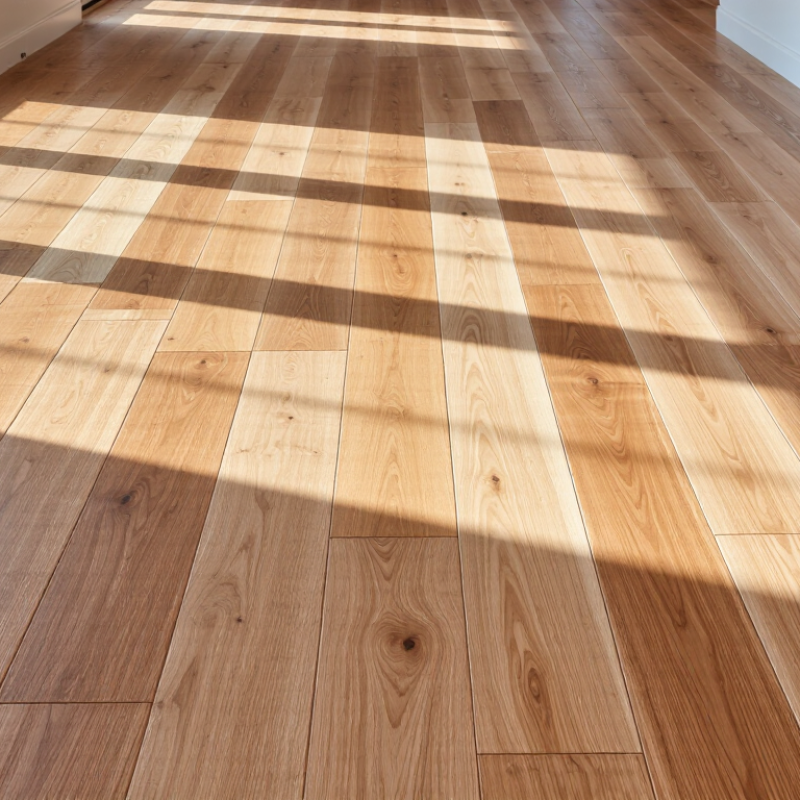
| Maple species | Hard Maple
Acer saccharum | Janka hardness: approximately 1,450 lbf
Dense, fine-grained hardwood commonly used for high-traffic interiors. | Usually creamy white to pale tan with subtle grain. Natural boards can include light brown mineral streaks. | Residential living areas, offices, retail interiors, and other spaces requiring a relatively hard flooring surface. | High hardness, clean grain, good resistance to everyday indentation, and a bright contemporary appearance. | Its relatively low porosity can make some stains appear less uniform. Color variation should be approved before production. |
| Maple species | Red Maple
Acer rubrum | Janka hardness: approximately 950 lbf
Hardness varies by growing conditions and board location. | White to light reddish-brown heartwood with moderate grain variation and occasional darker streaks. | Bedrooms, living rooms, hospitality areas, and projects seeking a softer, warmer maple appearance. | Warm natural tone, attractive grain variation, and generally easier machining than harder maple species. | More susceptible to dents than hard maple. Specify a suitable wear layer and protective finish for commercial use. |
| Maple species | Silver Maple
Acer saccharinum | Typical Janka range: approximately 750–950 lbf
Values vary with the source and grading method. | Light cream to pale brown with a relatively open, sometimes irregular grain pattern. | Moderate-traffic residential interiors and projects where a lighter, more economical maple look is desired. | Light color, natural character, and broad availability in some regional markets. | Lower hardness and greater movement sensitivity require careful acclimation and moisture control. |
| Maple species | European Maple
Acer pseudoplatanus | Typical Janka hardness: approximately 1,050 lbf
Exact values vary by test standard and timber origin. | Usually pale yellow-white to light brown, with a restrained grain and occasional fine figuring. | European-style interiors, light Scandinavian designs, and projects requiring a calm, uniform visual field. | Balanced hardness, pale appearance, and compatibility with clear or lightly pigmented finishes. | Confirm the applicable grading rules, legal timber documentation, and moisture content for the destination market. |
| Engineered construction | 3-layer construction | Commonly includes a top maple wear layer, a cross-layered core, and a bottom balancing layer. | Can provide a stable maple surface while using less solid maple than a solid plank. | Residential installations and projects with moderate seasonal humidity changes. | Improved dimensional stability compared with solid wood and efficient use of the maple top layer. | Core quality, adhesive type, layer balance, and manufacturing tolerances should be verified through technical documentation. |
| Engineered construction | Multi-layer plywood construction | Typically uses several cross-oriented wood layers beneath a maple wear layer. Total thickness commonly ranges from 12–20 mm. | Supports a broad range of plank widths and surface treatments. | Wide-plank residential projects, commercial interiors, and climates with greater seasonal humidity variation. | Good dimensional stability and suitability for floating, glue-down, or nail-down systems when approved by the manufacturer. | Check formaldehyde-emission classification, adhesive performance, core voids, and delamination resistance. |
| Maple wear layer | Standard wear layer | Approximately 2–3 mm of visible maple veneer or lamella. | Offers the appearance of maple while keeping the overall product relatively cost-efficient. | Bedrooms, low-to-moderate traffic residences, and projects with limited future refinishing needs. | Lower material consumption and often a more accessible price point. | Refinishing capability is limited and depends on the remaining thickness, sanding method, and flooring technician. |
| Maple wear layer | Premium wear layer | Approximately 4–6 mm of maple wear layer, depending on product design. | Allows deeper character treatments and may support professional sanding over the service life. | High-value residences, hospitality projects, and selected commercial applications. | Greater long-term service potential and stronger visual depth after finishing. | Higher cost and weight. Confirm the manufacturer’s permitted sanding depth and maintenance instructions. |
| Color category | Natural clear maple | Usually uses a clear or lightly ambering finish without strong pigment. | Displays the original pale cream, tan, and light brown tones of maple. | Minimalist, Nordic, contemporary, and bright interior schemes. | Timeless appearance and easy coordination with neutral furniture and wall colors. | Natural maple can develop a warmer tone with light exposure. Obtain a finished sample for approval. |
| Color category | Whitewashed maple | Uses a white or pale pigment beneath or within the protective finish. | Soft white, pale beige, or chalky appearance with reduced visual contrast. | Coastal, Scandinavian, modern farmhouse, and low-contrast interior concepts. | Creates a bright visual effect and can reduce the apparent yellowing of natural wood. | Pigment consistency is important. Strong texture may create uneven color on open or irregular grain. |
| Color category | Warm honey or amber maple | Uses a warm-toned stain, oil, or ambering finish system. | Gold, honey, caramel, or light amber tones that emphasize warmth. | Traditional, transitional, lodge-inspired, and hospitality interiors. | Creates a welcoming appearance and can complement warm cabinetry and natural stone. | Warm finishes may intensify over time. Confirm color under the project’s actual lighting conditions. |
| Color category | Gray or greige maple | Uses gray, beige-gray, or mixed-tone pigment over the maple surface. | Cool gray, taupe, or balanced greige with the maple grain still visible. | Contemporary interiors and projects coordinated with gray textiles or stone. | Provides a modern neutral appearance and can moderate the natural warmth of maple. | Thin or uneven pigmentation may reveal sanding marks, edge color differences, or board-to-board variation. |
| Surface finish | UV-cured polyurethane | Factory-applied resin finish cured with ultraviolet light; commonly available in matte, satin, or semi-gloss. | Can be clear, stained, or pigmented with consistent factory coverage. | Busy residential areas, offices, retail, and hospitality projects. | Good factory consistency, efficient production, and generally easy routine cleaning. | Finish repair may be less invisible than on an oil-finished floor. Follow the specified cleaner and maintenance schedule. |
| Surface finish | Aluminum-oxide-enhanced finish | Uses aluminum oxide particles within a factory-applied coating to improve surface wear resistance. | Available in clear and colored systems, most commonly with a low- to medium-sheen appearance. | High-use residential and selected commercial environments. | Strong abrasion resistance for routine foot traffic and reduced visible wear in many applications. | Scratch resistance is not the same as scratch proofing. Repairs and recoating can require specialist methods. |
| Surface finish | Hardwax oil | Penetrating oil and wax system that leaves a low-sheen, tactile surface. | Enhances grain and often produces a natural, hand-finished appearance. | Premium residences, boutique hospitality, and interiors emphasizing natural material character. | Local repair and refresh options may be practical when the correct maintenance products are used. | Requires regular maintenance and prompt removal of spills. Maintenance frequency depends on traffic and product formulation. |
| Surface texture | Smooth planed surface | Low-relief surface with minimal mechanical texture. | Clean, refined appearance; highlights maple’s subtle grain and color variation. | Modern, minimalist, formal, and accessibility-focused interiors. | Easy to clean and comfortable underfoot; furniture moves more easily across the surface. | Surface scratches and dust may be more visible under directional light than on textured finishes. |
| Surface texture | Wire-brushed | Soft grain fibers are mechanically removed to create shallow linear relief. | Provides a gently aged appearance and emphasizes the direction of the grain. | Contemporary rustic, transitional, and high-use residential interiors. | Light surface marks and everyday dust can be less visually prominent than on a fully smooth floor. | Grooves require careful cleaning. The final color can vary where pigment collects in the brushed texture. |
| Surface texture | Hand-scraped or distressed | Irregular shallow-to-moderate surface marks created mechanically or by controlled hand work. | Character-rich appearance with visible variation between boards. | Rustic, farmhouse, heritage, and informal hospitality interiors. | Designed variation can help blend minor everyday marks into the overall visual character. | Not ideal where a uniform appearance is required. Confirm the allowable range of knots, color variation, and distressing. |
| Edge profile | Micro-beveled edges | Small bevel along the long edges, and sometimes the ends, of each plank. | Creates subtle plank definition after installation. | Wide-plank floors, rustic designs, and installations where board separation is desired. | Can visually reduce the effect of minor height differences between adjacent boards. | Bevels can collect dust and may be more noticeable in pale-color floors. |
| Edge profile | Square edges | Plank edges meet with minimal visible recess after installation. | Produces a continuous, modern surface with less visual separation. | Contemporary interiors and carefully leveled glue-down installations. | Clean visual appearance and fewer edge grooves to maintain. | Subfloor flatness and installation accuracy are especially important because height differences are more apparent. |
| Plank format | Medium-width plank | Commonly approximately 120–180 mm wide and 1,200–2,200 mm long; product ranges vary. | Balanced visual rhythm with moderate board repetition. | Most residential rooms and mixed-size commercial spaces. | Versatile, easier to handle, and generally simpler to install than extra-wide boards. | Confirm the proportion of full-length boards, random lengths, and end-joint distribution. |
| Plank format | Wide plank | Often approximately 180–300 mm wide, with length and thickness determined by the product design. | Fewer joints and a more spacious, premium visual effect. | Large residences, open-plan interiors, showrooms, and hospitality spaces. | Highlights the maple surface and creates a calm appearance with fewer visible seams. | Requires strict subfloor flatness, appropriate adhesive or fixing method, and careful moisture management. |
| Installation suitability | Floating installation | Planks connect together over an approved underlay without direct bonding to the subfloor. | Visual result depends on the locking profile and edge design. | Suitable residential renovations when the product is specifically approved for floating installation. | Faster installation and easier replacement of selected boards in some systems. | Subfloor flatness, room size limits, expansion gaps, underlay performance, and acoustic requirements must be checked. |
| Installation suitability | Glue-down installation | Planks are bonded to a prepared subfloor using a compatible flooring adhesive. | Usually provides a firm feel with reduced hollow sound compared with some floating systems. | Large open areas, concrete subfloors, commercial interiors, and radiant-heating systems approved by the manufacturer. | Good dimensional restraint and design flexibility for many engineered products. | Requires adhesive compatibility, subfloor moisture testing, surface preparation, and professional installation. |
| Climate and moisture | Moisture control requirement | Wood flooring must be acclimated and installed within the manufacturer’s specified temperature and relative-humidity range. | Correct moisture control helps preserve the intended color, joints, and surface appearance. | All global markets, especially regions with seasonal humidity, coastal conditions, or air-conditioned interiors. | Reduces the risk of excessive gaps, cupping, crowning, and dimensional movement. | Do not use a generic acclimation period alone. Follow product-specific moisture readings and installation instructions. |
| Sustainability documentation | Responsible sourcing and emissions documentation | Relevant documents may include timber legality records, chain-of-custody evidence, and indoor-air-emission test results. | Documentation does not change the visual appearance but supports project compliance. | Public projects, green-building programs, institutional interiors, and regulated import markets. | Improves supply-chain transparency and helps buyers meet regional procurement requirements. | Requirements differ by destination. Verify the exact document scope, test standard, validity period, and product batch coverage. |