Aegis provides affordable, low power Wi-Fi sensor network solutions that make a ubiquitous sensing world come alive and a full line of controlled temperature cabinets. Laboratory, Pharmacy and Chromatography refrigerators and freezers which are designed to meet the dimensional and temperature requirements of the scientific community.

2026 Top Types of Produce Trays for Global Buyers
Produce Trays are becoming a strategic choice for growers, packers, retailers, and global produce buyers. The right tray must protect delicate fruit, support ventilation, and remain stable through cold storage and transport. A crushed berry punnet can mean product loss, customer complaints, and wasted logistics costs.
The scale of the challenge is significant. The FAO reports that 13.2% of global food is lost between harvest and retail. UNEP also estimates that 19% of food is wasted at retail, food service, and household levels. These figures make tray design more than a packaging decision. It becomes a supply-chain decision. Smithers’ research on sustainable packaging also identifies recyclable materials, lightweighting, and fiber-based formats as major industry directions through the decade.
Jean-Pierre Emond, a recognized produce-packaging researcher, has emphasized, “Packaging is an integral part of the cold chain.” That principle guides this 2026 overview. It explains how rPET, molded fiber, corrugated board, and recyclable polypropylene trays perform in real distribution conditions. It also considers stack strength, moisture resistance, airflow, visibility, and automated packing compatibility.
Not every “sustainable” tray performs equally well. A fiber tray may absorb moisture. A lightweight plastic tray may deform under stacking pressure. Claims can also become vague without testing. This is where buyers need evidence, not attractive slogans. The following guide compares leading Produce Trays by application, material, protection, cost, and end-of-life practicality for international purchasing decisions.
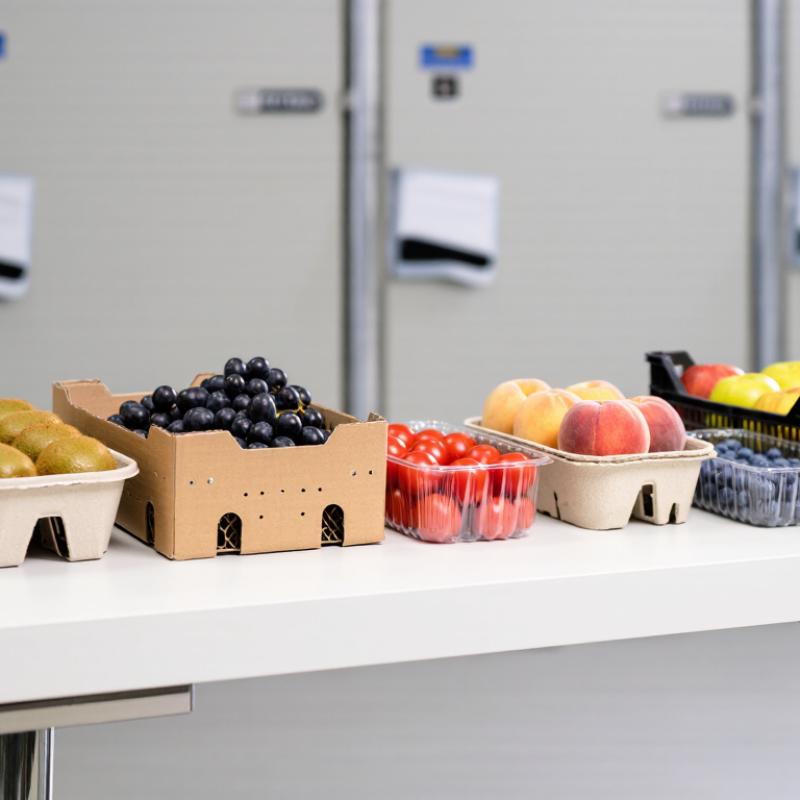
Table of Contents [Hide]
What Produce Trays Are and Why They Matter in Global Supply Chains
Produce trays are shallow containers designed to hold, protect, and move fresh fruits and vegetables. They may use molded fiber, recycled plastic, foam, or corrugated board. Each material changes ventilation, strength, moisture control, and cost.
In export handling, tray design affects more than appearance. A ventilated plastic tray can reduce heat around leafy greens during pallet storage. A rigid tray can prevent bruising when peaches travel through several loading points. Fiber trays suit buyers seeking lower plastic use, but moisture may weaken them during wet handling. Corrugated trays remain practical for mixed shipments because they are light and easy to label.
Produce trays also connect farms, cold stores, transporters, and retailers. Standard dimensions help workers stack pallets safely and use warehouse space efficiently. Open sides improve airflow, yet they can expose delicate produce to impact. Tight nesting saves return space, but cleaning requirements may become harder. From warehouse checks, small design details often create large losses. A tray that fits one pallet perfectly may waste space on another.
Temperature, humidity, product weight, and route length should guide selection. Buyers should request compression data, food-contact information, and cleaning instructions before purchase. Trial shipments reveal problems that samples cannot. Not every “reusable” tray performs well. That point deserves more attention.
Contact Us
Phone
Toll Free: 1-800-796-2344
OH: 513 204 5837
PA: 215-281-9180
support@site_367d8ed1-a876-442b-a1d7-b1fc1cf4ed19