Aegis provides affordable, low power Wi-Fi sensor network solutions that make a ubiquitous sensing world come alive and a full line of controlled temperature cabinets. Laboratory, Pharmacy and Chromatography refrigerators and freezers which are designed to meet the dimensional and temperature requirements of the scientific community.

7 UVC Sterilization Tips for Global Buyers?
Global buyers need more than a bright lamp and a promising product sheet. Uvc Sterilization decisions involve performance, safety, documentation, and local operating conditions. A device may work well in a clean laboratory, yet perform poorly inside a dusty cabinet or crowded room. Shadows matter. Surface distance matters. So does maintenance.
William F. Kowalski, a recognized UVGI researcher and author of the Ultraviolet Germicidal Irradiation Handbook, states, “UVGI is a line-of-sight technology.” This simple warning deserves serious attention. UVC energy cannot reliably disinfect areas it cannot reach. Buyers should examine irradiance measurements, exposure time, sensor placement, shielding, and verified test methods. Marketing claims alone are not enough.
This guide presents seven practical Uvc Sterilization tips for international purchasing teams. It considers product validation, safety interlocks, material compatibility, replacement parts, technical files, and after-sales support. It also highlights questions that are easy to miss during a fast procurement cycle. For example, can operators confirm lamp output after months of use? Are instructions clear for every intended market? Does the supplier explain limitations honestly?
Small details decide real results.
No guide removes every uncertainty. Some recommendations may require adjustment for air systems, water treatment, or surface applications. That is normal. Reliable buyers compare evidence, request independent test data, and involve qualified safety professionals before deployment. A lower price can become expensive when calibration, training, or compliance records are missing. The strongest purchase is not always the most powerful device. It is the one that delivers measurable performance safely, consistently, and transparently.
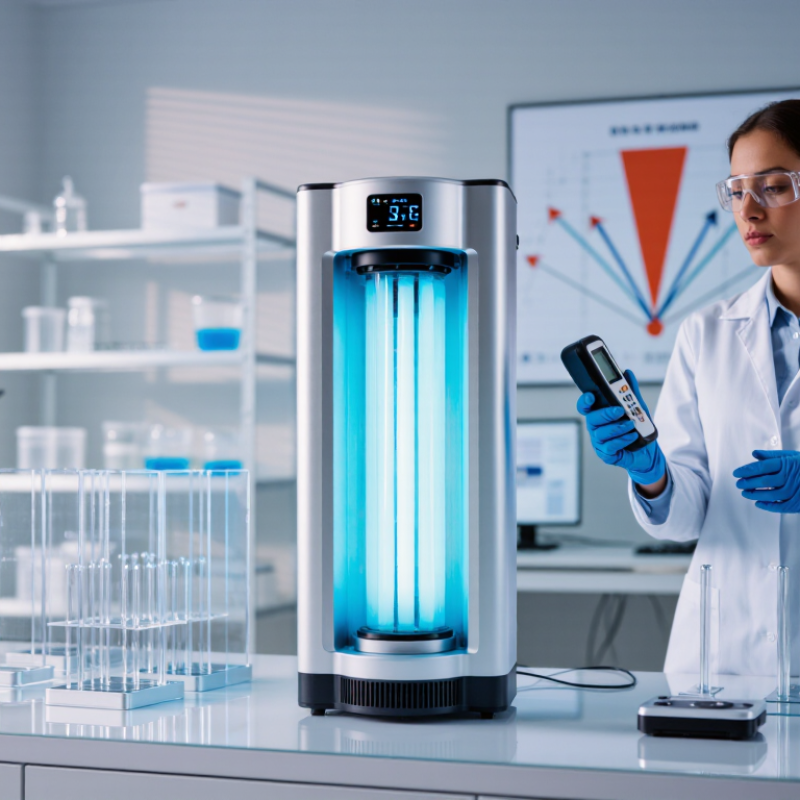
Table of Contents [Hide]
Define UV-C Scope: 200–280 nm and 254 nm Lamp Performance
For global buyers, “UV-C” is a range, not a performance guarantee. It covers 200–280 nm, where microbial inactivation can occur. However, output at each wavelength matters. A 254 nm low-pressure lamp is a familiar reference in air and surface systems. Many microorganisms respond strongly near this region. Do not treat nominal wavelength as delivered dose. A lamp can say 254 nm and still underperform after aging, fouling, or poor airflow. My practical check is simple: request a measured irradiance map, not only a lamp datasheet. That evidence is more useful.
Tip 1: Confirm the spectrum, lamp type, and test distance. Ask whether measurements were taken through a sleeve, grille, or protective window.
Tip 2: Compare dose, not wattage. Dose equals irradiance multiplied by exposure time, usually expressed in mJ/cm². A compact chamber may need longer exposure than expected. Shadows, dust, and uneven loading reduce the real dose. Place sensors where products actually sit. For 254 nm systems, verify lamp output after warm-up, not immediately after switching on. Temperature changes can affect stability. I have seen attractive specifications fail because testing used an empty chamber. That is a useful warning, although installations can behave differently. Ask for independent test methods, organism data, and uncertainty ranges. “Up to 99.9%” means little without conditions.
Tip 3: Review safety and maintenance details before purchase. UV-C can injure eyes and skin, so interlocks, shielding, warning labels, and leakage checks deserve attention. Confirm replacement intervals and cleaning procedures. If the spectrum approaches shorter wavelengths, ask about ozone generation and ventilation. A 200 nm claim needs extra scrutiny. It may not describe useful treatment output. Keep records of irradiance checks and failed tests. Small records prevent large assumptions.
Contact Us
Phone
Toll Free: 1-800-796-2344
OH: 513 204 5837
PA: 215-281-9180
support@site_367d8ed1-a876-442b-a1d7-b1fc1cf4ed19