Aegis provides affordable, low power Wi-Fi sensor network solutions that make a ubiquitous sensing world come alive and a full line of controlled temperature cabinets. Laboratory, Pharmacy and Chromatography refrigerators and freezers which are designed to meet the dimensional and temperature requirements of the scientific community.

What Are the Best Acoustic Panels for 2026?
Choosing the best Acoustic Panels for 2026 is less about chasing a top-rated product and more about matching treatment to the room. A home office with sharp video-call echoes needs different coverage than a music room with flutter between bare walls. Even a few panels can help, when they are placed thoughtfully. More is not always better.
Sound expert Julian Treasure has said, “We are losing our listening.” His point reaches beyond panels: room sound shapes how clearly we hear voices, music, and everyday details. Acoustic panels absorb some sound energy, reducing reflections; they do not block all outside noise or fix every acoustic problem. That distinction matters.
This guide compares panel types, materials, thicknesses, finishes, and practical installation choices. It also considers published absorption ratings, while noting that results depend on placement and room conditions. A fabric-wrapped panel may suit a meeting space, while a wood-slat design can balance absorption with a more finished look. Check the dimensions against your wall, and look for clear product specifications rather than broad promises. Small details count.
There is no single winner for every room. A panel that looks elegant in a showroom may disappoint above a desk or behind a microphone. Measurements help, but they cannot replace listening in the actual space. This guide aims to make the trade-offs visible, though no shortlist can predict every room’s quirks.
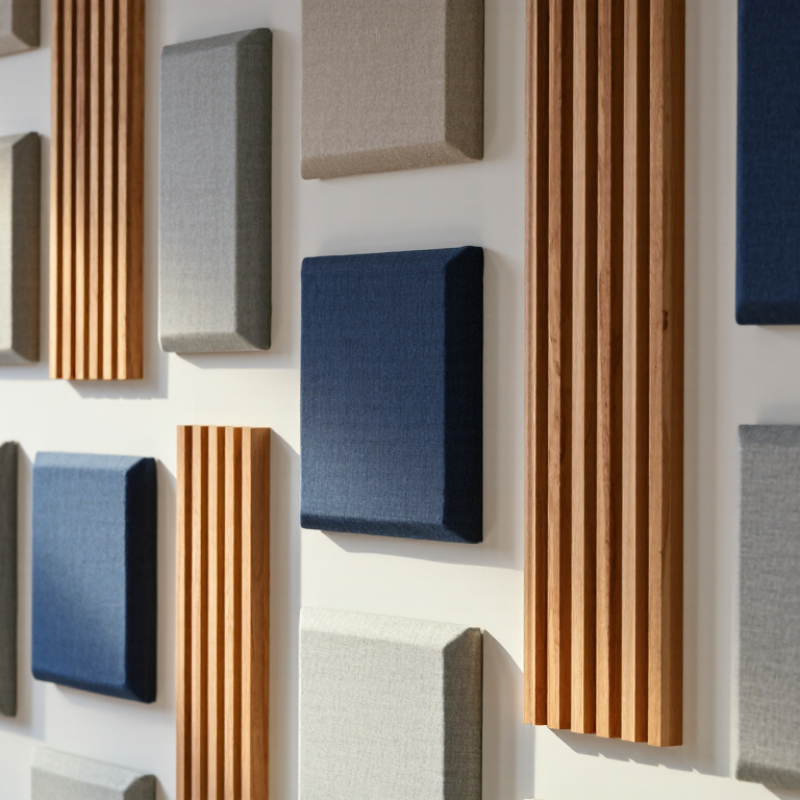
Table of Contents [Hide]
How Acoustic Panels Work and Where They Are Used
Acoustic panels improve how a room sounds by absorbing some sound energy, especially mid- and high-frequency reflections. Many use porous materials, such as mineral fiber or dense foam, behind a fabric or perforated surface. Sound passes into the material, where friction converts a portion of its energy into heat. The result can be clearer speech and less fluttering echo, not silence. That distinction matters. Panels do not usually stop noise traveling through walls; that requires different construction and sealing. Panel thickness, material, and the air gap behind a panel all affect its performance, so appearance alone is a poor guide.
Panels are useful in home offices, classrooms, meeting rooms, music practice spaces, and restaurants where hard surfaces make voices blur together. In a small office, a few panels near reflective walls may help video calls sound less hollow. Small rooms reveal it. Placement should respond to the actual problem: listen for sharp echoes, then treat key reflection points on walls or ceilings. Covering every surface can make a room feel unnaturally dull, while leaving the ceiling untreated may preserve distracting reflections. Results depend on the room, furnishings, and panel specifications. A practical approach is to add a modest amount, listen again, and adjust; even careful placement can miss an awkward corner or an unexpected source of echo.
Contact Us
Phone
Toll Free: 1-800-796-2344
OH: 513 204 5837
PA: 215-281-9180
support@site_367d8ed1-a876-442b-a1d7-b1fc1cf4ed19