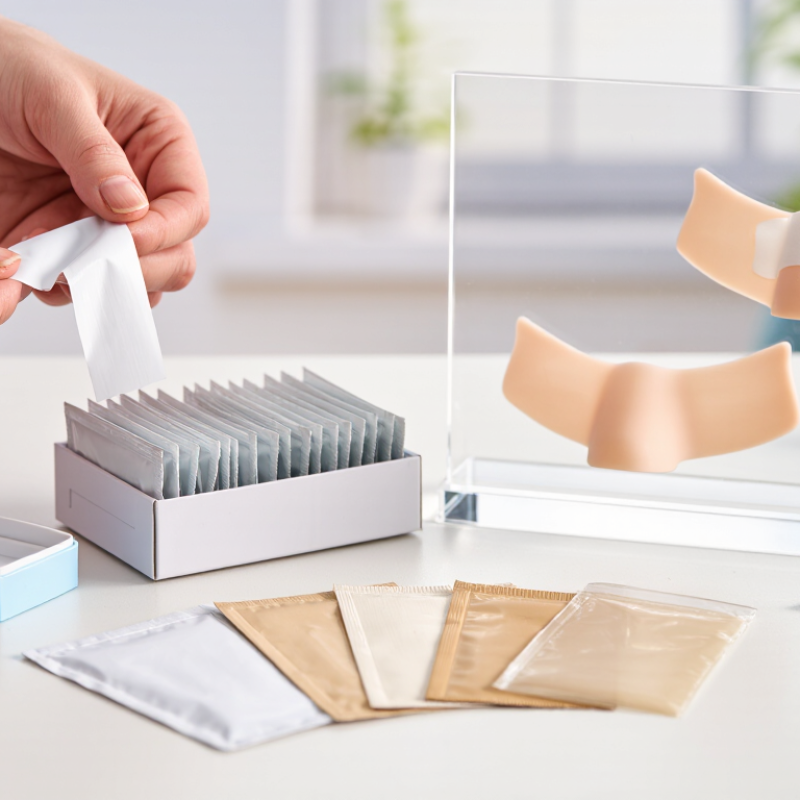
| Product Function | Mechanical lifting performance | Confirm the strip uses a flexible spring or support element that provides a measurable lifting effect without causing excessive pressure or discomfort. Test performance on different nose shapes. | A strip may adhere well but still provide limited mechanical support if the spring element, curvature, or stiffness is unsuitable. | Technical specification, product samples, and a comparative user-test report. |
| Adhesive | Adhesive type and skin compatibility | Confirm whether the adhesive is acrylic, rubber-based, silicone-based, or another pressure-sensitive adhesive. Ask whether it is intended for short-term contact with intact skin. | Adhesive chemistry affects holding power, residue, removal comfort, odor, and the risk of skin irritation. | Material declaration, adhesive technical data sheet, and skin-contact test information. |
| Adhesive | Peel adhesion and holding power | Request test conditions rather than relying on a single strength claim. Results should identify substrate, dwell time, peel angle, peel speed, temperature, and humidity. ASTM D3330 may be used for pressure-sensitive adhesive peel testing where applicable. | Adhesion results can vary significantly according to skin condition, oil, sweat, temperature, and test method. | Laboratory test report with method, equipment, sample size, and acceptance criteria. |
| Skin Safety | Irritation and sensitization assessment | Confirm that the finished strip, including adhesive and backing materials, has been assessed for skin irritation and sensitization when required by the intended market and product claims. ISO 10993 methods may be relevant for products making medical-device claims. | Testing only the adhesive raw material may not represent the safety profile of the complete finished product. | Finished-product safety test report, material list, and allergen or restricted-substance declaration. |
| User Comfort | Recommended wear time | Confirm the validated wear period under normal conditions. Common consumer use is overnight or several hours, but the exact period must be supported by product testing and labeling instructions. | A longer claimed wear time requires reliable adhesion and acceptable skin comfort throughout use. | Wear-time validation, user trial summary, and application and removal instructions. |
| Product Structure | Backing material | Confirm whether the backing is nonwoven fabric, paper, polymer film, or a multilayer construction. Check flexibility, breathability, tear resistance, and surface finish. | The backing influences comfort, appearance, moisture handling, and resistance to stretching during application. | Material specification, cross-section description, and samples from the intended production version. |
| Product Structure | Size and shape options | Confirm overall length, width, curvature, adhesive area, and available sizes. A practical development process should include fit testing on narrow, medium, and wide nose profiles. | Incorrect dimensions can cause lifting at the edges, uncomfortable pressure, or inadequate coverage. | Dimensioned technical drawing, tolerance table, and samples in each requested size. |
| Quality Control | Dimensional tolerances | Specify measurable tolerances for length, width, spring-element position, adhesive coverage, liner alignment, and cutting accuracy. Tolerances should be agreed before mass production. | Consistent dimensions are essential for uniform appearance, fit, and functional performance. | Approved product drawing, inspection standard, and batch inspection records. |
| Quality Control | Appearance and defect criteria | Define acceptable limits for wrinkles, bubbles, contamination, exposed adhesive, misalignment, incomplete cutting, color variation, and damaged release liners. | Clear defect criteria reduce disputes and prevent inconsistent quality between production batches. | Golden sample, visual defect catalog, and pre-shipment inspection checklist. |
| Packaging | Individual packaging and hygiene protection | Confirm whether each strip is individually sealed or supplied in another protective format. Verify that packaging prevents contamination, adhesive exposure, moisture damage, and premature liner separation. | The packaging protects adhesive performance and supports clean, convenient application by the end user. | Packaging drawing, packaging material specification, seal-strength test, and packed samples. |
| Packaging | Packaging claims and sterilization status | Confirm whether the product is non-sterile or sterile. Do not use sterile claims unless the product and packaging have been validated for the intended sterilization and shelf-life conditions. | Sterility is a regulated claim in many markets and requires appropriate validation and labeling controls. | Sterilization validation, packaging validation, or written confirmation that the product is non-sterile. |
| Regulatory | Target-market compliance | Confirm the destination markets, product classification, labeling rules, language requirements, and applicable restrictions on medical or therapeutic claims. Requirements vary by country and intended use. | A product suitable for one market may require different documents, labeling, or claims control in another market. | Regulatory assessment, label artwork, declaration documents, and applicable test reports. |
| Materials | Restricted substances and material traceability | Confirm the materials comply with applicable chemical restrictions for the destination market. The supplier should be able to identify material lots used in each production batch. | Traceability supports recalls, complaint investigation, and verification of consistent raw-material quality. | Material declaration, restricted-substance statement, supplier lot records, and batch traceability procedure. |
| Shelf Life | Shelf life and storage conditions | Confirm the stated shelf life, recommended temperature and humidity range, packaging protection, and whether adhesive performance is monitored during stability testing. | Heat, humidity, light, and prolonged storage can affect tack, liner release, backing strength, and appearance. | Stability or aging data, storage instructions, and production-date and expiry-date format. |
| Production Capacity | Monthly capacity and peak-season planning | Confirm normal monthly output, available production lines, lead time for raw materials, and capacity during seasonal demand peaks. Capacity should be stated for the exact product configuration. | A supplier may have sufficient general capacity but limited capacity for customized materials, packaging, or colors. | Capacity statement, production schedule, and written delivery plan. |
| Order Terms | Minimum order quantity and pricing basis | Request separate quantities and prices for standard product, customized size, customized packaging, printed packaging, and new tooling. Confirm whether prices include packaging and inspection. | The lowest unit price may exclude tooling, artwork, testing, packaging, or other order-related costs. | Itemized quotation, MOQ table, tooling quotation, and payment terms. |
| Customization | Artwork, tooling, and sample approval | Confirm the approval process for technical drawings, packaging artwork, color references, barcodes, and pre-production samples. Production should begin only after written approval. | Documented approval reduces the risk of incorrect dimensions, printing, packaging, or labeling. | Approved artwork, signed specification, pre-production sample, and change-control record. |
| Inspection | Pre-shipment inspection procedure | Agree on inspection quantity, sampling method, critical and major defect limits, functional checks, packaging checks, and report format before production. | Pre-shipment inspection provides an objective release decision before goods leave the factory. | Inspection standard, inspection report template, and retained sample policy. |
| Supply Chain | Batch consistency and retained samples | Confirm that production batches are identified and that representative samples are retained for a defined period. Verify that changes to adhesive, backing, liner, or packaging require notification. | Batch control helps compare future orders and investigate complaints or performance changes. | Batch coding procedure, retained-sample records, and material-change notification policy. |
| Commercial Risk | Defect handling and replacement policy | Confirm the procedure, response time, evidence requirements, and cost responsibility for defective goods, shortages, transit damage, or non-conforming packaging. | A clear corrective-action process protects both parties when quality problems occur after delivery. | Written quality agreement, claims procedure, and corrective-action form. |
| Final Verification | Sample-to-mass-production consistency | Compare the approved sample with the first production batch for dimensions, adhesive behavior, appearance, packaging, labeling, and performance before releasing the full shipment. | The approved sample is useful only when the supplier controls production to the same specification. | Golden sample, first-article inspection report, production sample photos, and test results. |