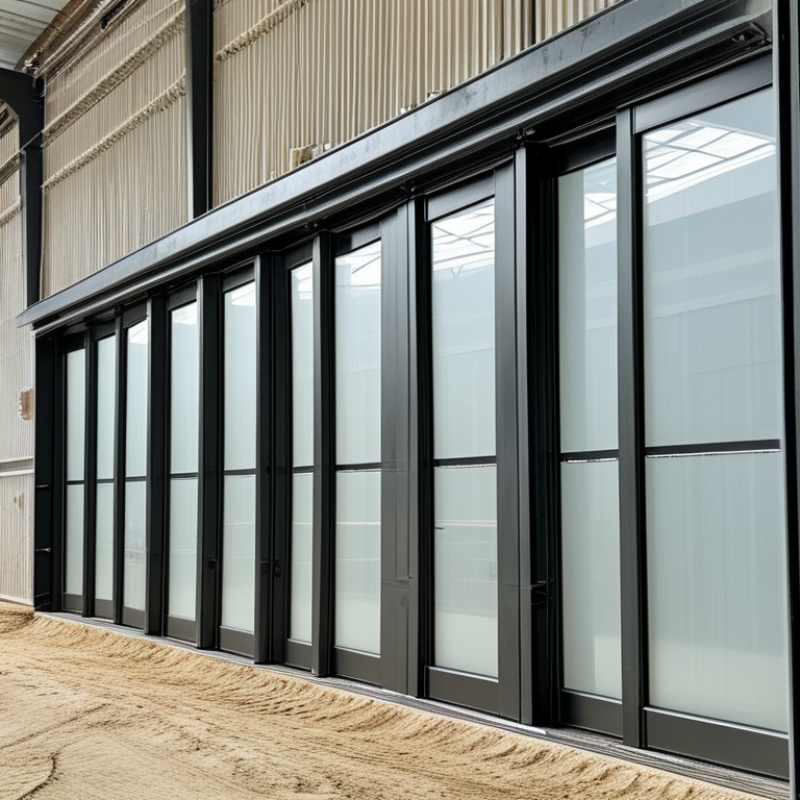
| Best Application | Large industrial, warehouse, agricultural, and equipment openings where the structure can support a floor track. | Clean floor areas, service bays, interior partitions, and openings where a recessed or unobstructed floor track is preferred. | Locations requiring a wide clear opening with limited side or stacking space, including hangars, workshops, and logistics areas. | Confirm the opening dimensions, available stacking area, traffic pattern, wind exposure, and frequency of operation. |
| Typical Clear Opening | Often suitable for very wide openings; the practical limit is determined by panel weight, track design, structural support, and site conditions. | Suitable for wide openings when the header, carrier system, and building structure are engineered for the total suspended load. | Commonly used for wide openings because panels fold into compact stacks; the final width depends on panel count and folding geometry. | Request an engineered layout rather than selecting a door from opening width alone. |
| Load Transfer | Most door weight transfers to the floor through rollers and a properly supported track. | Most door weight transfers to the header, beam, or supporting structure through hangers and carriers. | Weight is transferred through hinges, guides, rollers, and either the floor or header, depending on the configuration. | Obtain structural calculations for headers, jambs, slabs, foundations, and any attachment points. |
| Floor Requirements | Requires a level, durable surface and an accurately aligned track. Drainage and debris control are important outdoors. | Can reduce floor-track obstructions, but the bottom guide or floor receiver still needs a stable and accurately aligned surface. | Requires a level operating area and adequate support for floor guides, hinges, or bottom rollers where used. | Check slab flatness, expansion joints, drainage, corrosion exposure, and the ability to repair the track area. |
| Header and Structural Support | Usually requires less suspended load at the header, although wind, guide, and operating forces still require proper support. | Requires careful header and beam design because the door assembly is suspended above the opening. | Requires support for the folding hardware and wind loads; the support arrangement varies by top-hung or bottom-rolling design. | Have a qualified engineer verify dead load, wind load, impact load, deflection limits, and connection details. |
| Manual Operation | Can be practical for moderate-use openings when panels are balanced and rollers are correctly adjusted. | Can operate smoothly with low rolling resistance, but misalignment or excessive header deflection can increase effort. | Manual operation is practical for smaller panel groups; larger assemblies may require assisted or powered operation. | Measure the expected opening cycles per day and specify an acceptable opening force for operators. |
| Powered Operation | Suitable for frequent traffic when the drive system includes appropriate controls, safety devices, and emergency release provisions. | Suitable for automated operation when the carrier, drive, and header structure are rated for the complete door assembly. | May use synchronized drives or powered operators; folding movement requires careful control of panel sequence and pinch points. | Specify duty cycle, travel speed, power supply, control location, emergency operation, and safety interlocks. |
| Wind and Weather Exposure | Can perform well outdoors when the track, guides, locks, seals, and frame are designed for the site wind conditions. | Needs robust guides and locking points to control movement caused by wind and pressure differences. | Requires strong hinges, guides, locking hardware, and panel connections because folded leaves can experience concentrated forces. | Use the project-specific design wind speed and exposure category; do not rely only on nominal door size. |
| Security and Locking | Can incorporate multiple locking points, floor receivers, drop bolts, and personnel access hardware. | Can provide secure locking, but suspended panels must be held against movement at the floor and jambs. | Requires coordinated locking across meeting stiles, jambs, and intermediate panel joints. | Define security level, forced-entry resistance, padlock or cylinder requirements, and emergency egress needs. |
| Personnel Door Integration | May include a wicket or personnel door, provided the design maintains safe clearances and structural integrity. | May include a personnel door, but the suspended system must accommodate the additional weight and hardware. | Can integrate a personnel door, although hinge zones, thresholds, and safety interlocks need special attention. | Confirm accessibility, threshold height, panic hardware, self-closing requirements, and interlock logic. |
| Routine Inspection | Inspect tracks, rollers, guides, stops, locks, seals, fasteners, and drainage paths at least periodically and more often in harsh environments. | Inspect carriers, hangers, header connections, guides, anti-jump devices, stops, and locking hardware. | Inspect hinges, rollers, guides, panel joints, locks, cables or drives, and pinch-point guards. | Set inspection intervals according to usage, environment, manufacturer instructions, and applicable safety requirements. |
| Lubrication | Lubricate serviceable bearings, hinges, and hardware only with products compatible with the door system; keep rolling tracks clean. | Lubricate approved carrier and hinge points while preventing excess lubricant from attracting dust to tracks or guides. | Lubricate hinges, pivots, rollers, and approved drive components according to the maintenance schedule. | Use a written lubrication chart that identifies the component, lubricant type, quantity, and service interval. |
| Cleaning and Corrosion Control | Remove dirt, gravel, ice, and standing water from tracks; inspect exposed steel, welds, fasteners, and coatings. | Keep the floor guide and carrier path free of debris; inspect suspended components for corrosion or cracking. | Clean between folding leaves and around hinges; check coatings, seals, fasteners, and drainage areas. | Select finishes and materials based on humidity, salt spray, chemicals, temperature, and wash-down procedures. |
| Expected Service Life | Service life depends on engineering, materials, environment, maintenance, impact frequency, and operating cycles. | Service life depends strongly on header rigidity, carrier condition, alignment, and the number of operating cycles. | Service life is influenced by hinge and roller wear, panel alignment, wind exposure, and operating discipline. | Ask for a cycle rating, replaceable wear-part list, inspection criteria, and documented maintenance requirements. |
| Spare Parts Planning | Keep critical rollers, bearings, guides, seals, locks, fasteners, and drive components available for the expected service period. | Keep carriers, hangers, anti-jump devices, guides, stops, seals, and locking parts identified by a service drawing. | Keep hinges, rollers, guides, cables or belts, locks, seals, and control components appropriate to the operating system. | Require part numbers, material specifications, lead times, interchangeability information, and storage recommendations. |
| Warranty and Documentation | Request written coverage for structure, finish, hardware, drives, controls, and workmanship with clear exclusions. | Request documentation covering suspended hardware, carriers, structural attachments, controls, and adjustment procedures. | Request separate coverage details for panels, hinges, rollers, guides, operators, controls, and safety devices. | Review warranty duration, required maintenance records, response limits, site exclusions, and commissioning requirements. |
| Long-Term Technical Support | Choose a supplier or service provider able to support alignment, roller replacement, automation, and weather-seal renewal. | Choose support that can inspect header attachments, carrier wear, deflection, alignment, and operating controls. | Choose support that can maintain hinge geometry, synchronized movement, guides, locks, and safety systems. | Verify service coverage, emergency response process, technician qualifications, remote troubleshooting, and planned modernization options. |
| Best Overall Choice When | Floor capacity is strong, extremely wide access is needed, and a robust floor track is acceptable. | Floor clearance is important and the building can safely support the suspended door load. | Maximum opening width and compact stacking are priorities, and the site can accommodate folding hardware and maintenance access. | Compare total installed cost, downtime risk, maintenance access, spare-parts availability, energy requirements, and lifecycle cost. |