Aegis provides affordable, low power Wi-Fi sensor network solutions that make a ubiquitous sensing world come alive and a full line of controlled temperature cabinets. Laboratory, Pharmacy and Chromatography refrigerators and freezers which are designed to meet the dimensional and temperature requirements of the scientific community.

How to Choose the Best Commercial Display Fridge
Choosing a Commercial Display Fridge is not just a matter of picking an attractive cabinet. The right unit must keep products at a suitable, consistent temperature while making them easy to see and reach. A fridge that looks impressive in a showroom may perform differently in a warm, busy shop. Details matter.
Start with what you plan to display. Bottled drinks, packaged desserts, and fresh sandwiches have different storage and presentation needs. Check the usable shelf space, temperature controls, and airflow design. A crowded cabinet can restrict circulation, so advertised capacity may not tell the whole story. Measure the installation area, including door clearance and access for delivery. Small oversight, big headache.
Visibility also deserves careful thought. Clear glazing, well-placed lighting, and adjustable shelves can help products stand out without making restocking difficult. Compare energy use and operating noise, too, especially if the fridge will run near customers or staff. Ask suppliers about warranty coverage, service availability, and cleaning requirements. These practical questions are easy to overlook when price dominates the decision.
This guide outlines how to compare key features, match a fridge to your products, and assess long-term running needs. Specifications offer a useful starting point, but real conditions matter. Check product details against your space, daily sales volume, and local operating environment. There may be no perfect model—only a better-informed choice.
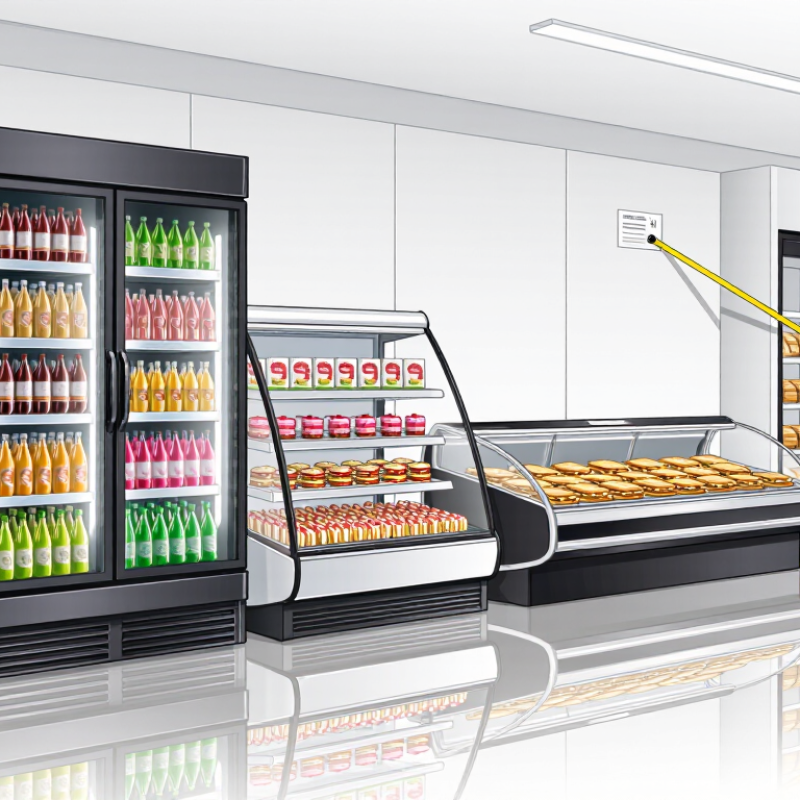
Table of Contents [Hide]
Set Food-Safety Targets: FDA Food Code Limits Cold Holding to 41°F (5°C)
Choosing a commercial display fridge starts with a clear food-safety target. The FDA Food Code sets cold holding for time/temperature control for safety foods at 41°F (5°C) or below. Check local requirements too, since jurisdictions may adopt different code editions or rules. A glowing digital display is useful, but it does not prove that every item is cold enough.
Look for even cooling across shelves, a reliable temperature display, and quick recovery after the door opens. Busy service matters. Warm room air can rush in each time a customer reaches for a drink or a worker restocks cut fruit.
Avoid packing shelves tightly; blocked vents can leave warm pockets near the front or corners. Measure food with a calibrated probe, and use a separate thermometer to verify cabinet conditions. Check temperatures during busy periods, not only before opening.
A fridge may read 38°F while newly loaded food remains too warm. That detail is easy to miss.
Record readings and act when temperatures rise, following your food-safety procedures. Equipment helps control risk, but it cannot replace careful loading, cleaning, and monitoring.
Even experienced teams can overlook a door left ajar.
Contact Us
Phone
Toll Free: 1-800-796-2344
OH: 513 204 5837
PA: 215-281-9180
support@site_367d8ed1-a876-442b-a1d7-b1fc1cf4ed19