Aegis provides affordable, low power Wi-Fi sensor network solutions that make a ubiquitous sensing world come alive and a full line of controlled temperature cabinets. Laboratory, Pharmacy and Chromatography refrigerators and freezers which are designed to meet the dimensional and temperature requirements of the scientific community.

How to Choose a Stainless Steel Door Hinge
Choosing the right stainless steel door hinge affects more than smooth movement. It influences security, weather resistance, appearance, and long-term maintenance. A hinge may look strong on a sample door, yet fail when exposed to heavy traffic, coastal air, or poor alignment.
This guide explains how to evaluate Door Hinge Stainless Steel products with practical care. It considers grade, load capacity, hinge size, bearing design, screw quality, and installation conditions. For example, a 100-kilogram entrance door needs more than a visually attractive hinge. Its hinges must share the load evenly and tolerate repeated opening cycles. Stainless steel grade also matters. Grade 304 suits many indoor and general outdoor applications, while Grade 316 usually offers better resistance near saltwater.
Details matter.
Real installation experience often reveals problems that product images hide. Thin leaves can bend. Weak screws can loosen. Incorrect spacing can create friction, even with a premium hinge. These mistakes are easy to overlook during purchasing. I have also seen buyers choose polished finishes without checking cleaning requirements. That choice can increase visible fingerprints and maintenance work.
A reliable selection process compares manufacturer specifications with the door’s actual weight, thickness, usage frequency, and environment. Independent testing, clear tolerances, and consistent documentation add confidence. Still, no hinge is universally perfect. The best choice balances performance, budget, appearance, and installation skill. This article provides a practical framework for making that decision with fewer assumptions and more dependable results.
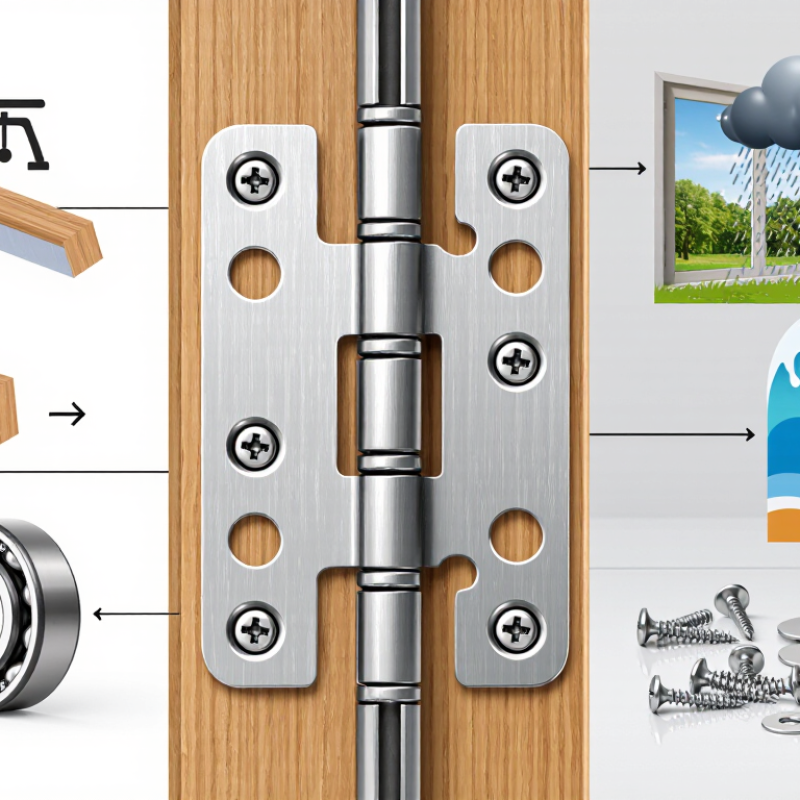
Table of Contents [Hide]
Define Door Load and Duty: Use ANSI/BHMA A156.1 Cycle Grades
Choosing a stainless steel door hinge starts with load, not appearance. Estimate leaf weight, width, closer force, and hardware mass. A heavy fire-rated door can punish a light hinge quickly. Traffic matters too. A service corridor may see hundreds of openings daily. A lobby door may experience more impact, weather, and abuse. Record actual use when possible. Guessing is convenient, but often wrong.
ANSI/BHMA A156.1 provides measurable duty classes. According to BHMA’s published cycle criteria, Grade 3 is tested to 350,000 cycles, Grade 2 to 1.5 million, and Grade 1 to 2.5 million cycles. These figures are laboratory endurance targets, not promises for every installation. They help match hinge duty to project risk. Low-use interior doors may suit Grade 3. Busy commercial openings usually deserve Grade 1 or Grade 2 review. Confirm the adopted edition and project specification before ordering.
Stainless steel selection still needs context. Check compatible knuckles, pins, fasteners, and frame materials. Mixed metals can create corrosion problems in damp locations. Verify hinge size, screw pattern, clearances, and bearing design. Field inspections often find misalignment, not weak steel, causing early wear. I still recheck the closer and frame before blaming the hinge. That step is easy to miss. Consider salt air, cleaning chemicals, temperature, and impact. Cycle grade cannot measure every site condition.
Contact Us
Phone
Toll Free: 1-800-796-2344
OH: 513 204 5837
PA: 215-281-9180
support@site_367d8ed1-a876-442b-a1d7-b1fc1cf4ed19