Aegis provides affordable, low power Wi-Fi sensor network solutions that make a ubiquitous sensing world come alive and a full line of controlled temperature cabinets. Laboratory, Pharmacy and Chromatography refrigerators and freezers which are designed to meet the dimensional and temperature requirements of the scientific community.

What Is a Metal Cutting Board and Is It Worth Buying?
A Metal Cutting Board looks almost indestructible. Its smooth steel or aluminum surface resists deep scratches, stains, and lingering food odors. That promise sounds appealing in busy kitchens. Yet durability is only one part of the decision.
Professional knife educator and author Chad Ward offers a useful warning: “A cutting board should protect the knife, not fight it.” His point matters here. Metal surfaces can feel clean and stable, but they may dull a sharp blade faster than quality wood or plastic. They can also create a harsh ringing sound during chopping. Some models slide on wet counters. That detail is easy to overlook.
Hygiene remains a genuine advantage. Nonporous metal does not absorb meat juices or onion smells. It can be washed quickly and dried without much effort. However, cleanliness still depends on proper handling. A neglected board can spread contamination across a countertop, regardless of its material.
The real question is not whether metal is “better.” It is whether its strengths match your routine. A Metal Cutting Board may suit pastry work, heavy preparation, or kitchens needing rapid sanitation. It may disappoint cooks who value knife sharpness and quieter chopping.
There is no perfect answer. Metal feels modern, but modern does not always mean practical. Before buying, consider your knives, counter space, noise tolerance, and cleaning habits. The most impressive surface may still be the wrong one for daily use.
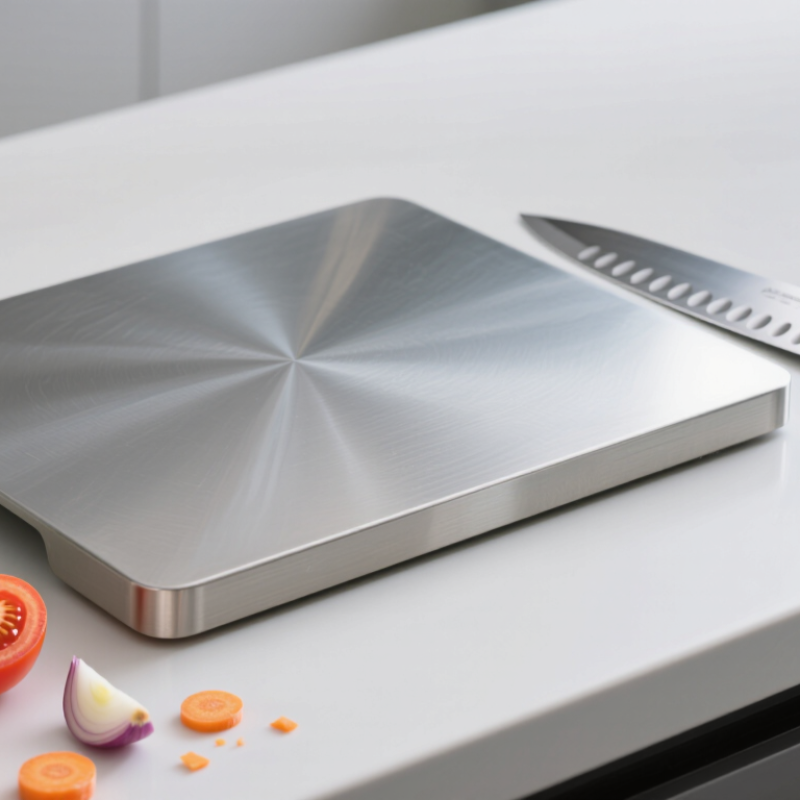
Table of Contents [Hide]
What Is a Metal Cutting Board?
A metal cutting board is a rigid food-preparation surface made from stainless steel, aluminum, or another food-contact metal. It usually has a flat, nonporous face and rounded edges. Unlike wood, it does not absorb meat juices, onion water, or cooking oils. A properly finished surface can be washed, sanitized, and dried quickly.
The FDA Food Code 2022 describes food-contact surfaces as smooth, durable, corrosion-resistant, and easy to clean. Metal can meet these requirements when its finish remains intact. That detail matters. Scratches, dents, and rough welds can trap residue and make cleaning less reliable. I have found that a cold metal surface also makes wet dough and butter feel firmer during preparation.
Hygiene is the stronger argument. A 2011 study in Emerging Infectious Diseases estimated 47.8 million foodborne illnesses annually in the United States, with 127,839 hospitalizations. A metal board cannot prevent contamination by itself. Handwashing, separation of raw foods, and proper cooking still control the main risks. It can, however, reduce absorption between uses. That is useful.
There are trade-offs. Metal can dull knife edges faster than softer materials. It may also slide unless rubber feet or a damp towel hold it steady. I would not treat every shiny board as professional equipment. Surface quality varies, and that deserves closer inspection.
Contact Us
Phone
Toll Free: 1-800-796-2344
OH: 513 204 5837
PA: 215-281-9180
support@site_367d8ed1-a876-442b-a1d7-b1fc1cf4ed19