Aegis provides affordable, low power Wi-Fi sensor network solutions that make a ubiquitous sensing world come alive and a full line of controlled temperature cabinets. Laboratory, Pharmacy and Chromatography refrigerators and freezers which are designed to meet the dimensional and temperature requirements of the scientific community.

What Is a Stainless Steel Water Bottle?
What Is a Stainless Steel Water Bottle?
A Stainless Steel Water Bottle is a reusable container made primarily from corrosion-resistant steel. Its chromium content helps form a thin protective layer when exposed to air. That layer limits rust and gives the bottle its familiar polished or brushed surface.
Harry Brearley, the British metallurgist linked to early stainless-steel development, reportedly called his invention “rustless steel.” The phrase was simple, but not completely accurate. Stainless steel can stain, scratch, or corrode under harsh conditions. That matters when choosing a bottle.
Many bottles use 18/8 stainless steel, commonly known as Type 304. Some use Type 316, which offers stronger resistance to chlorides and salty environments. The grade is important, but it is only one part of the product. The lid, gasket, welds, inner coating, and manufacturing quality also affect performance.
A good bottle feels balanced in the hand. Its mouth should be wide enough for cleaning, ice, and inspection. The inner wall should have no sharp seams or unusual odors. Insulated models usually contain a double-wall structure, creating a vacuum that slows heat transfer. Cold water stays cold longer. Hot drinks remain warm.
Still, “safe” should not become a careless promise. Food-contact suitability depends on materials, construction, cleaning, and proper use. A damaged seal may harbor residue. Strong odors can signal poor cleaning, not necessarily dangerous steel.
This guide examines the material, grades, insulation, hygiene, durability, and practical limits of a Stainless Steel Water Bottle. It also questions a common assumption: reusable does not automatically mean maintenance-free.
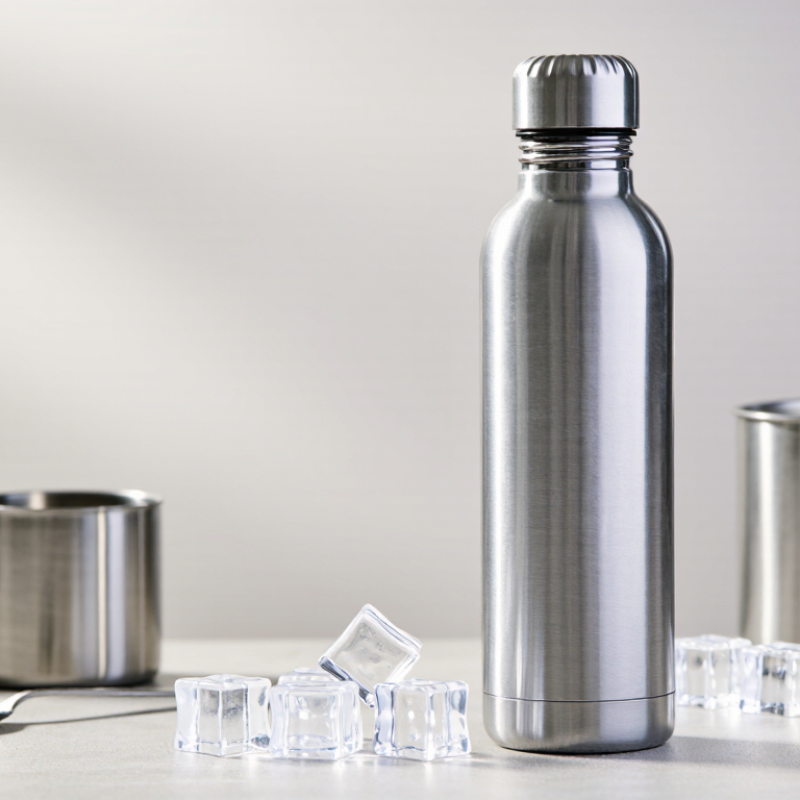
Table of Contents [Hide]
Definition and Basic Structure of a Stainless Steel Water Bottle
A stainless steel water bottle is a reusable container designed to hold drinking water and other common beverages. Its main body is made from corrosion-resistant stainless steel, often selected for food-contact use. Unlike disposable plastic containers, it is built for repeated washing and daily carrying. The structure starts with the bottle wall, which gives the container strength and shape. A narrow neck reduces spills, while the mouth allows filling, pouring, and cleaning. Some openings are wide enough for ice, but that design can affect the seal.
The cap usually contains threads, a drinking opening, and a silicone or rubber gasket. That small ring matters. If it sits unevenly, water may leak inside a bag. Some models use a single steel wall. Others use two walls with a vacuum between them. This insulation slows heat transfer, but it does not make the bottle unbreakable or permanently cold.
In regular use, I check the cap threads and gasket after washing because residue can collect in hidden grooves. Warm water, mild dish soap, and a soft brush are usually practical cleaning tools. Harsh scraping can damage surfaces, especially around the mouth. I once focused only on the shiny exterior and overlooked the cap. That was a useful mistake. A stainless steel bottle includes more than its visible body; its opening, closure, seal, and optional insulation all affect everyday performance.
Contact Us
Phone
Toll Free: 1-800-796-2344
OH: 513 204 5837
PA: 215-281-9180
support@site_367d8ed1-a876-442b-a1d7-b1fc1cf4ed19