Aegis provides affordable, low power Wi-Fi sensor network solutions that make a ubiquitous sensing world come alive and a full line of controlled temperature cabinets. Laboratory, Pharmacy and Chromatography refrigerators and freezers which are designed to meet the dimensional and temperature requirements of the scientific community.

7 Tips for Choosing a Reformer Pilates Machine
Choosing a reformer Pilates machine requires more than comparing glossy frames and spring colors. Your decision affects movement quality, safety, maintenance, and daily motivation.
Demand is rising. ClassPass’s 2024 Look Back Report identified Pilates as the most-booked workout worldwide, with bookings increasing 66% year over year. The Global Wellness Institute reported that the global wellness economy reached $6.3 trillion in 2023. These figures show strong interest, but they do not prove that every reformer suits every body, room, or budget.
Start with evidence, not excitement. The seven tips ahead examine carriage stability, spring resistance, shoulder-rest design, footbar adjustment, materials, storage, and after-sales support. A quiet carriage should glide smoothly across a small studio floor. A solid frame should remain steady during controlled footwork. It should also accommodate different leg lengths and training levels.
Joseph Pilates, whose teaching shaped modern reformer practice, is widely credited with saying, “Physical fitness is the first requisite of happiness.” That principle still matters. A machine should support consistent, controlled movement, rather than encourage impressive-looking routines. Fit matters more than novelty.
There is no perfect purchase. A heavier commercial model may feel secure, yet occupy valuable space. A compact home reformer may save money, yet offer fewer adjustments. My own evaluation would still question long-term spring durability, because product pages rarely reveal enough testing detail. These practical tips aim to make that uncertainty visible before payment, installation, and the first workout.
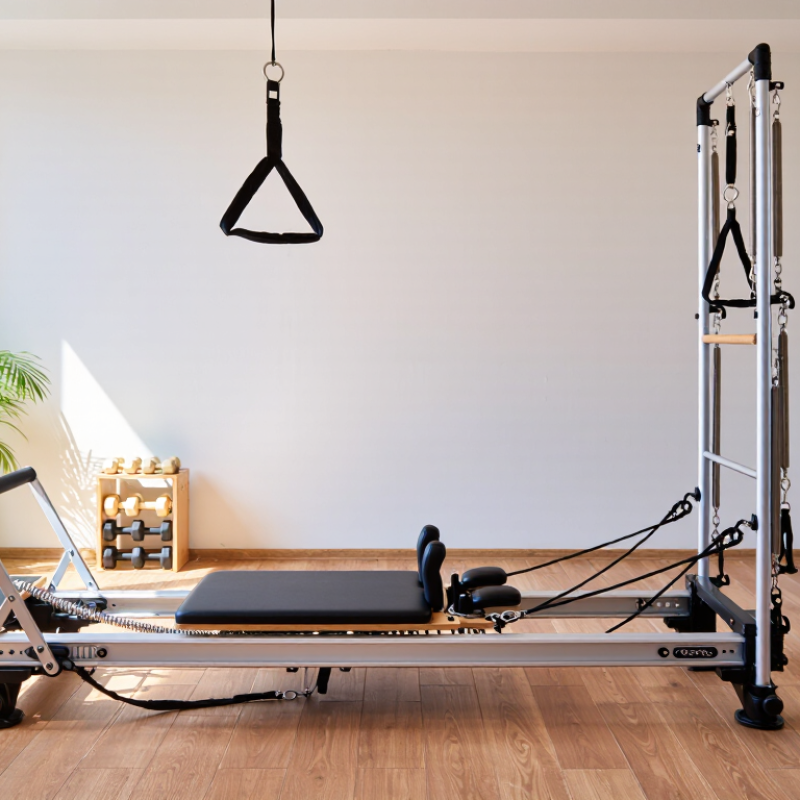
Table of Contents [Hide]
Understanding Reformer Pilates and Its Main Uses
The reformer is not simply a sliding platform.
It combines a moving carriage, adjustable springs, a footbar, and straps. These parts create resistance in both directions. That makes the machine useful for controlled strength, mobility, balance, and body awareness. Unlike floor exercises, it gives the feet and hands clear contact points. Small spring changes can alter the challenge quickly.
Movement & Training
Common uses include core training, posture practice, joint-friendly strength work, and movement retraining. An instructor may use footwork to build leg control, then add straps for hip mobility.
With a box, the same carriage can support seated, kneeling, or lying exercises. Beginners often need slower springs, not heavier ones. More resistance is not always more progress.
For pain, pregnancy, or recent surgery, professional medical guidance matters. Pilates instruction cannot replace diagnosis.
When choosing a reformer, connect its features to your intended use.
Check carriage stability, smooth travel, spring options, and a footbar that adjusts securely. Measure ceiling height and storage space before buying. Leave room to step around it. Padding matters during longer sessions.
I once underestimated noise and reach distance; both affected consistency. A machine can look impressive yet feel awkward at home. Test the transitions, not only the exercises. Your ideal setup may be less advanced, but easier to use regularly.
Contact Us
Phone
Toll Free: 1-800-796-2344
OH: 513 204 5837
PA: 215-281-9180
support@site_367d8ed1-a876-442b-a1d7-b1fc1cf4ed19