Aegis provides affordable, low power Wi-Fi sensor network solutions that make a ubiquitous sensing world come alive and a full line of controlled temperature cabinets. Laboratory, Pharmacy and Chromatography refrigerators and freezers which are designed to meet the dimensional and temperature requirements of the scientific community.

China Top 10 Cleanroom Chiller System Manufacturers
Choosing a Cleanroom Chiller System is about more than comparing cooling capacity or price. Cleanrooms need stable conditions, often across long operating hours. A small temperature swing can affect humidity control, equipment performance, or sensitive production steps. The chiller must also work well with air-handling units, filters, pumps, and building controls. Details matter.
Cleanroom contamination-control expert William Whyte’s work offers a useful reminder, paraphrased here: “Control the room as a whole, not the chiller alone.” That principle helps frame this look at China’s top 10 cleanroom chiller system manufacturers. The comparison considers system design, temperature-control capability, energy performance, product documentation, installation support, and after-sales service. Buyers should check these points against their actual heat loads and operating conditions. A polished brochure is not proof of performance. Ask for technical data and service details.
No single manufacturer will suit every project. Some facilities need tight temperature stability; others prioritize redundancy, efficient part-load operation, or support for complex controls. Even a strong product can disappoint if commissioning or maintenance is weak. That part is easy to underestimate. The list is a starting point, not a substitute for engineering review. Verify specifications, references, and local service coverage before making a decision.
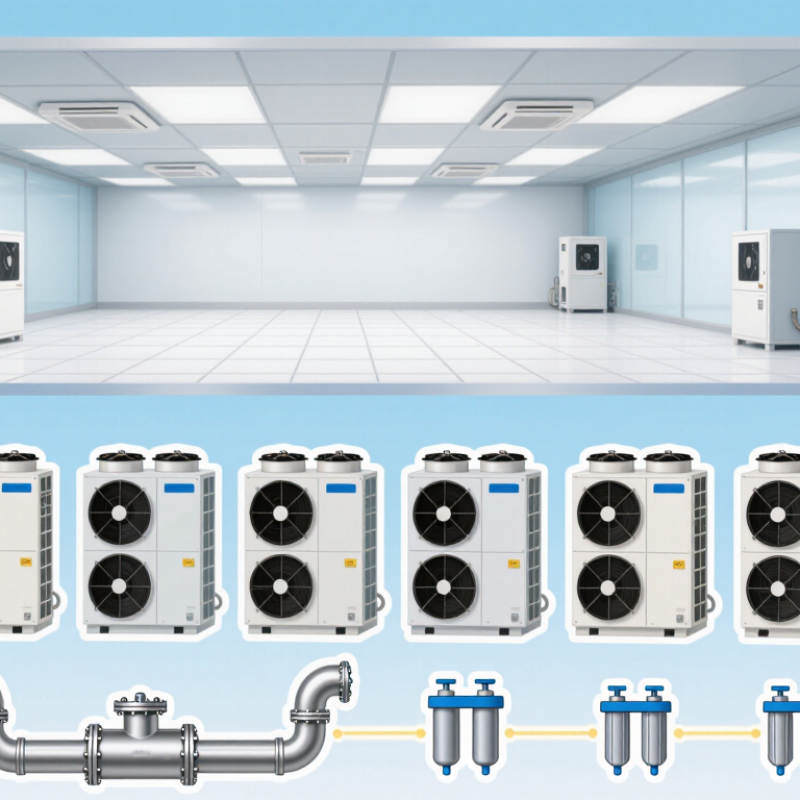
Table of Contents [Hide]
Cleanroom Chiller Systems: Purpose, Design, and Operating Principles
Cleanroom chiller systems remove heat from process equipment, lighting, people, and supply air while helping maintain stable room temperatures. They serve chilled-water coils in air-handling units; those coils cool and, when needed, dehumidify incoming air. The chiller does not control cleanliness by itself. Filters and airflow design do that work. Temperature stability still matters.
Design starts with measured loads, not just floor area. Engineers account for equipment heat, outdoor conditions, humidity targets, and future production changes. Lawrence Berkeley National Laboratory cleanroom energy benchmarking research reports that cleanrooms can use roughly 10 to 100 times more energy per floor area than typical offices, depending on process and cleanliness requirements.
That range is wide, but it highlights why load estimates and efficient controls matter. ASHRAE’s HVAC Applications guidance also emphasizes coordinated air-conditioning design for clean spaces. Redundancy may be appropriate where an interruption risks product quality.
In operation, chilled water circulates through the chiller and cooling coils, absorbing heat before returning warmer to the plant. Operators track supply-water temperature, return-water temperature, flow, and room humidity. Small drift matters. A rising return temperature may signal changing loads or poor heat transfer, but it is not a diagnosis on its own. Trend data and coil inspections help teams distinguish control problems from maintenance needs. Real systems are rarely as tidy as the design model.
Contact Us
Phone
Toll Free: 1-800-796-2344
OH: 513 204 5837
PA: 215-281-9180
support@site_367d8ed1-a876-442b-a1d7-b1fc1cf4ed19