Aegis provides affordable, low power Wi-Fi sensor network solutions that make a ubiquitous sensing world come alive and a full line of controlled temperature cabinets. Laboratory, Pharmacy and Chromatography refrigerators and freezers which are designed to meet the dimensional and temperature requirements of the scientific community.

What Are the Top 10 Types of Adhesive Electrode Pads?
Adhesive Electrode Pads connect modern therapy and monitoring devices with living skin. Their small surface hides complex design choices. Conductive gel, backing material, shape, flexibility, and peel strength can change signal quality and comfort. Dr. Tim Watson, a respected electrotherapy educator, describes the core principle clearly: “The electrode is the interface between the machine and the patient.”
That interface deserves closer attention. Grand View Research and Fortune Business Insights both report continued growth in the global electrotherapy market, supported by home treatment, rehabilitation, sports recovery, and clinical monitoring. Their market estimates differ, however. This difference reminds readers to question bold forecasts and examine each report’s definitions. Some studies group electrodes with complete devices, while others measure pads separately.
The top ten types therefore should not be ranked by popularity alone. TENS pads may prioritize pulse delivery. ECG electrodes need stable biosignal capture. EMS pads require dependable contact during muscle contraction. Hydrogel, foam, fabric, reusable, pediatric, and diagnostic designs solve different practical problems. A pad that feels comfortable on a dry forearm may fail after sweat, movement, or repeated removal.
Small details matter.
This guide compares the ten leading types through material structure, intended use, skin contact, durability, and handling experience. It also considers evidence from clinical practice, manufacturer specifications, FDA device information, and IEC 60601-2-10 safety expectations. No single pad is best for every user. That is the uncomfortable but useful conclusion. Performance depends on the device, the body site, the skin, and the person applying it.
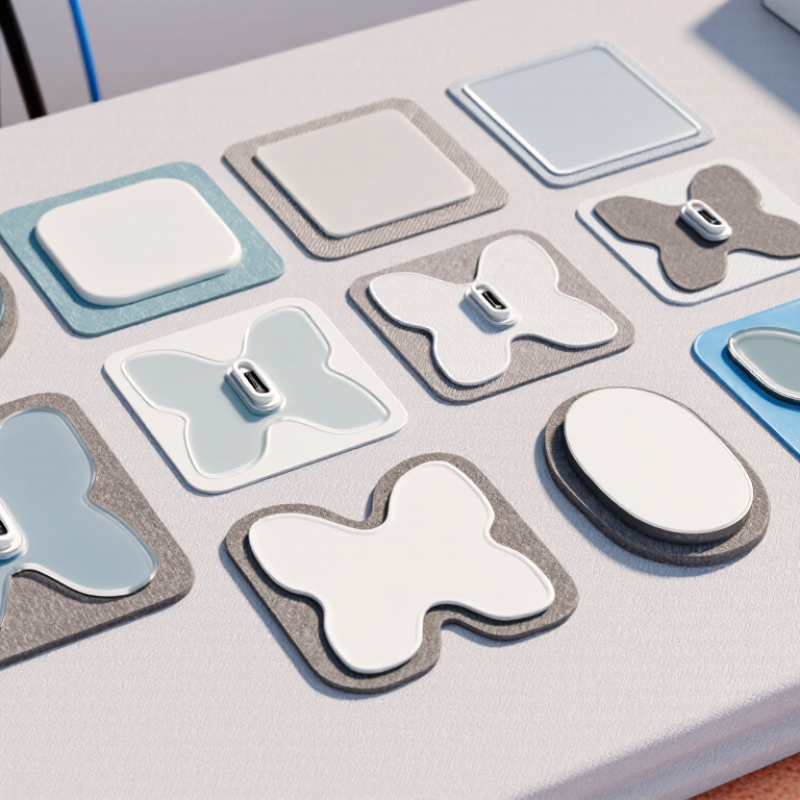
Table of Contents [Hide]
Definition and Basic Structure of Adhesive Electrode Pads
What Are the Top 10 Types of Adhesive Electrode Pads?
Definition and Basic Structure of Adhesive Electrode Pads
An adhesive electrode pad is a skin-contact component used to deliver or detect electrical signals. It combines adhesion, conductivity, and controlled current distribution. The basic structure usually includes a flexible backing, conductive layer, hydrogel, connector, and protective release liner. The hydrogel touches the skin and helps lower contact resistance. The backing keeps the pad stable during movement. Small details matter.
For TENS and EMS applications, the conductive layer may use carbon-based material or metallic coatings. The connector transfers energy from the lead wire into the electrode surface. Pad shape also affects comfort and current density. Rounded edges may reduce peeling during exercise. A poor fit can create uncomfortable hot spots. I may be oversimplifying, because performance also depends on skin moisture, pressure, and device settings. The WHO reports that 2.4 billion people live with conditions that may benefit from rehabilitation, highlighting the need for dependable accessory design (WHO, Rehabilitation, 2023). IEC 60601-2-10 also provides safety requirements for nerve and muscle stimulators.
Tips: Check the hydrogel condition before use. Avoid folded edges, damaged liners, or dried surfaces. Clean, dry skin usually improves contact. Do not judge quality by stickiness alone. A pad can feel strong yet distribute current poorly. Manufacturers and users should review storage temperature, reuse limits, and skin tolerance. Small practical checks are often missed.
Contact Us
Phone
Toll Free: 1-800-796-2344
OH: 513 204 5837
PA: 215-281-9180
support@site_367d8ed1-a876-442b-a1d7-b1fc1cf4ed19