Aegis provides affordable, low power Wi-Fi sensor network solutions that make a ubiquitous sensing world come alive and a full line of controlled temperature cabinets. Laboratory, Pharmacy and Chromatography refrigerators and freezers which are designed to meet the dimensional and temperature requirements of the scientific community.

Top 10 Fluorocarbon Coated Aluminum Window Manufacturers
Selecting a Fluorocarbon Coated Aluminum Window is about more than color or price. It means weighing coating durability, frame design, fabrication quality, thermal performance, and documented testing. The stakes are broad. The United Nations Environment Programme and Global Alliance for Buildings and Construction reported that buildings and construction accounted for 34% of global energy demand and 37% of energy- and process-related carbon dioxide emissions in 2022. Their 2023 Global Status Report makes building-product choices part of a larger efficiency conversation.
Coating claims deserve close inspection. AAMA 2605, published by the Fenestration and Glazing Industry Alliance, sets performance requirements for high-performance organic coatings on architectural aluminum. It offers a useful benchmark, but a standard alone does not prove that every finished window performs equally. Ask manufacturers for current test documentation, coating-system details, warranty terms, and project references. Check the actual assembly, too: glass, seals, drainage, and installation can matter as much as the finish.
This guide introduces ten manufacturers and compares the information buyers can verify, rather than treating a ranked list as a guarantee. Look for clear specifications, traceable quality controls, and examples suited to the intended climate and building type. A showroom sample may look flawless. Years of sun, rain, and handling are the harder test. And the evidence is not always easy to compare. That deserves a second look.
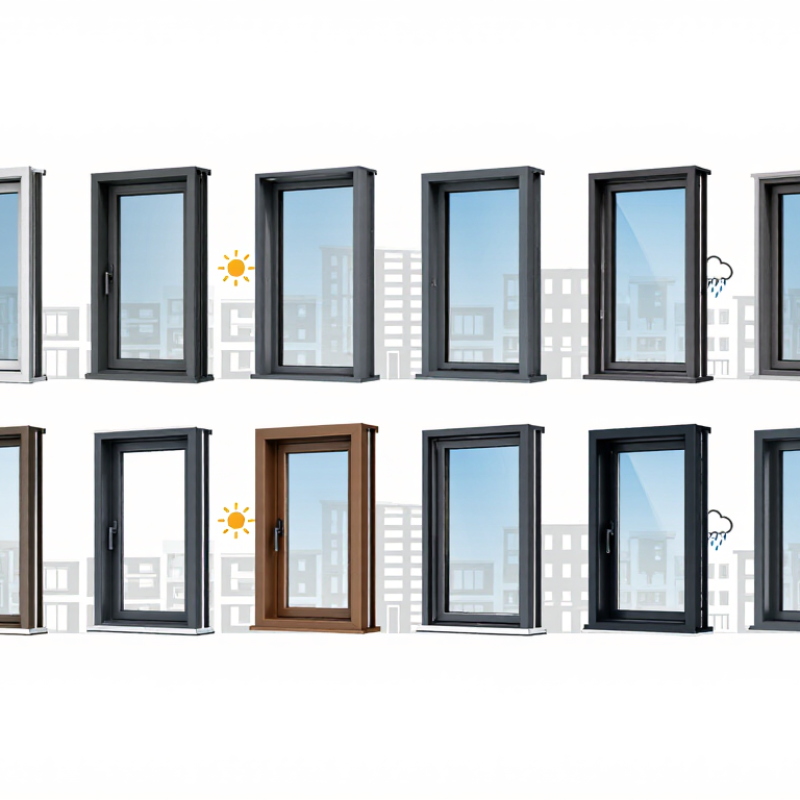
Table of Contents [Hide]
What Fluorocarbon-Coated Aluminum Windows Are
Fluorocarbon-coated aluminum windows use aluminum frames finished with a durable resin-based coating, often formulated with PVDF. Before coating, the metal is cleaned and prepared so the finish can bond evenly. After application and curing, the surface forms a thin, colored layer across the frame. It is not a separate protective shell. That distinction matters. Sunlight, rain, and airborne grime meet the coating first, rather than bare aluminum. Quality varies with resin content, pretreatment, coating thickness, and factory control. Those details are worth checking in product specifications.
The finish can help resist fading, chalking, and weathering while keeping slim frames visually consistent. A dark frame may feel warm under direct sun; color and orientation affect surface temperature. Cleaning usually needs mild detergent, water, and a soft cloth. Abrasive pads can scratch the finish. Still, the coating does not make a window waterproof or thermally efficient by itself. Glass, seals, drainage paths, hardware, and installation all shape actual performance. It is tempting to call the finish maintenance-free, but that overstates things. Inspect corners and joints occasionally. Small flaws can grow.
Contact Us
Phone
Toll Free: 1-800-796-2344
OH: 513 204 5837
PA: 215-281-9180
support@site_367d8ed1-a876-442b-a1d7-b1fc1cf4ed19