Aegis provides affordable, low power Wi-Fi sensor network solutions that make a ubiquitous sensing world come alive and a full line of controlled temperature cabinets. Laboratory, Pharmacy and Chromatography refrigerators and freezers which are designed to meet the dimensional and temperature requirements of the scientific community.

Top Skincare Pump Manufacturers for Global Buyers
A Skincare Pump is more than a small actuator above a bottle. It meters formula, limits messy contact, and has to keep working from the filling line to the final press at home. For global buyers, those details affect product protection, user experience, and supplier risk. The market is growing, but pump performance still depends on practical checks: dose consistency, closure fit, material compatibility, and repeatable output. A pump that looks refined can still sputter when paired with a thick cream. Small details matter.
Grand View Research valued the global cosmetic packaging market at US$34.4 billion in 2023 and forecast 5.4% annual growth from 2024 to 2030. That figure covers cosmetic packaging broadly, not skincare pumps alone, so it should not be read as a pump-market estimate. Packaging educator Walter Soroka describes packaging as “the science, art, and technology of enclosing or protecting products for distribution, storage, sale, and use.” For pump buyers, that principle is tangible: a bottle may face vibration in transit, temperature changes in storage, and repeated use beside a bathroom sink. This guide compares manufacturers through the factors that matter in those conditions, including dispensing precision, customization, production capability, and quality controls. Supplier claims are useful, but they are not test results. Ask for samples. Test them with your actual formula. That step is easy to overlook.
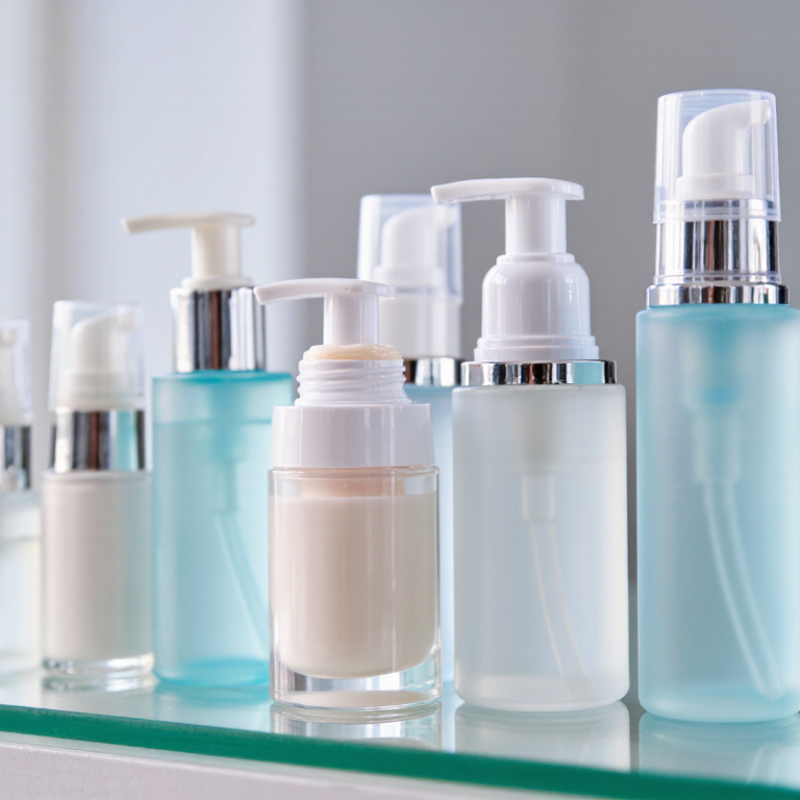
Table of Contents [Hide]
Understanding Skincare Pumps and Their Role in Product Packaging
A skincare pump is more than a dispenser; it helps protect the product and makes daily use predictable. Each press should deliver a reasonably consistent dose without requiring excessive force. That matters when someone applies a light serum with one hand or uses a richer lotion after washing. Small details matter.
The pump’s parts must suit the formula. Viscosity, oils, and suspended ingredients can affect how smoothly a product travels through the dip tube and nozzle. A formula that works in a jar may clog a narrow outlet or leave residue around the actuator. Packaging teams should test the actual product, not just water. Check priming, dose consistency, leakage, and how much product remains in the bottle. A few test cycles are not enough; repeated use can reveal sticking or changes in output.
The container also shapes the experience. A stable base is easier to press on a bathroom counter, while a locking clip can help prevent accidental discharge during transport. Airless designs may reduce repeated exposure to air, but they are not automatically suitable for every formula. Compatibility testing still matters. Sometimes the simplest pump performs best, though that can be less impressive in a product photograph.
Contact Us
Phone
Toll Free: 1-800-796-2344
OH: 513 204 5837
PA: 215-281-9180
support@site_367d8ed1-a876-442b-a1d7-b1fc1cf4ed19