Aegis provides affordable, low power Wi-Fi sensor network solutions that make a ubiquitous sensing world come alive and a full line of controlled temperature cabinets. Laboratory, Pharmacy and Chromatography refrigerators and freezers which are designed to meet the dimensional and temperature requirements of the scientific community.

What Is an Ultra Low Freezer and How Does It Work?
Ultra-low temperature (ULT) freezers preserve biological samples at temperatures far below a household freezer. Most laboratory models operate near -80°C, though setpoints and safe storage conditions depend on the sample and manufacturer’s guidance. These units support research, biobanking, and clinical laboratories, where a brief temperature rise can matter. Not just cold boxes.
Inside, a compressor system removes heat from an insulated cabinet. Many designs use two refrigeration stages, helping them reach very low temperatures. Thick insulation, sealed doors, and controlled airflow limit heat entering the chamber. Sensors track conditions, while alarms warn staff about temperature changes or power problems. Opening the door still matters: warm room air can enter, and recovery takes time.
The details are practical. A crowded rack, dusty filter, or poorly sealed gasket can affect performance. The International Society for Biological and Environmental Repositories’ 2023 Best Practices for Repositories emphasizes monitoring, maintenance, and documented storage procedures. The U.S. Department of Energy’s Better Buildings laboratory guidance also highlights laboratories as energy-intensive spaces, making freezer efficiency relevant to both operating costs and facility planning. These sources offer context, not a universal performance guarantee.
That distinction is easy to miss. A freezer’s display may show its setpoint, but it cannot prove every sample stayed within its required range. This article explains what ultra low freezers are, how their refrigeration systems work, and which operating details deserve close attention. No single setting suits every material; checking validated procedures and equipment specifications remains essential.
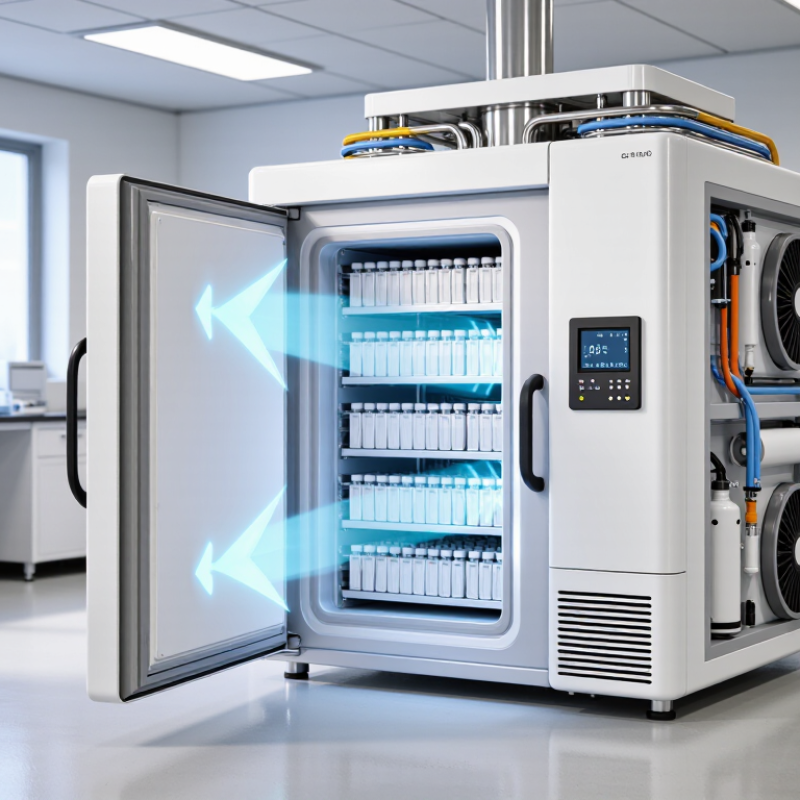
Table of Contents
[Hide]
What Defines an Ultra-Low-Temperature Freezer
An ultra-low-temperature (ULT) freezer is defined by its operating range, not simply by a “deep-cold” label. Many laboratory models operate between about −40°C and −86°C. A setpoint near −80°C is common for long-term storage of biological samples. Cold is not enough. Temperature stability and uniformity matter, especially when samples sit near the door or shelves.
Many conventional units use a cascade refrigeration system. Two linked cooling stages remove heat from the insulated cabinet and release it into the room. Sensors track cabinet temperature, while alarms warn staff if it rises beyond a chosen limit. A ULT freezer is therefore more than a very cold box. Its performance also depends on recovery after door openings, seal condition, loading, and room temperature. These details are easy to overlook.
Energy use offers another practical measure. My Green Lab’s Freezer Challenge guidance gives roughly 20 kWh per day as a typical ULT-freezer benchmark; actual consumption varies with unit size, age, settings, and use. That is a substantial daily load. A display reading of −80°C alone does not prove every shelf stays equally cold, so teams should review temperature logs and alarm records. Small gaps can matter.
Related Posts
-
How to Choose the Best Low Temperature Freezer for Your Needs?
-
Top 10 Benefits of Using Low Temperature Freezers for Food Storage?
-

How to Choose the Best Ultra Low Temperature Freezer?
-
10 Essential Tips for Choosing an Ultra Low Temperature Freezer
-
Top Research Freezers for Laboratory Efficiency and Performance?
-
How to Choose the Best Ultra Low Freezers for Your Lab?
Contact Us
Phone
Toll Free: 1-800-796-2344
OH: 513 204 5837
PA: 215-281-9180
support@site_367d8ed1-a876-442b-a1d7-b1fc1cf4ed19