Aegis provides affordable, low power Wi-Fi sensor network solutions that make a ubiquitous sensing world come alive and a full line of controlled temperature cabinets. Laboratory, Pharmacy and Chromatography refrigerators and freezers which are designed to meet the dimensional and temperature requirements of the scientific community.

What Is a Water Chiller Evaporator and How Does It Work?
A Water Chiller Evaporator is the quiet working chamber where heat leaves process water. It does not create cold directly. Instead, it transfers heat into a flowing refrigerant. That change sounds simple. The details are not.
Willis H. Carrier, a pioneer of modern air conditioning, wrote, “Air conditioning means the control of the humidity of the air, the control of its cleanliness, the control of its motion, and the control of its temperature.” His statement helps explain the wider purpose behind chiller design. A Water Chiller Evaporator supports that purpose by controlling temperature through a carefully managed refrigeration cycle. Warm water enters the evaporator shell or plate channels. Refrigerant absorbs its heat and boils at low pressure. Cooler water then returns to the building or production line.
The process depends on more than temperature difference. Flow rate, refrigerant pressure, tube cleanliness, and approach temperature all matter. A thin scale layer can act like an unwanted blanket. Poor flow can create uneven cooling. That is where field experience becomes important. Engineers inspect leaving-water temperature, suction pressure, vibration, and frost patterns. They also compare readings over time.
A perfect explanation would be misleading. Real systems behave differently. Manufacturer data gives direction, not certainty. This guide explores the evaporator’s construction, heat-transfer path, controls, common failures, and maintenance practices. It also asks a practical question: what happens when a small performance change signals a larger system problem?
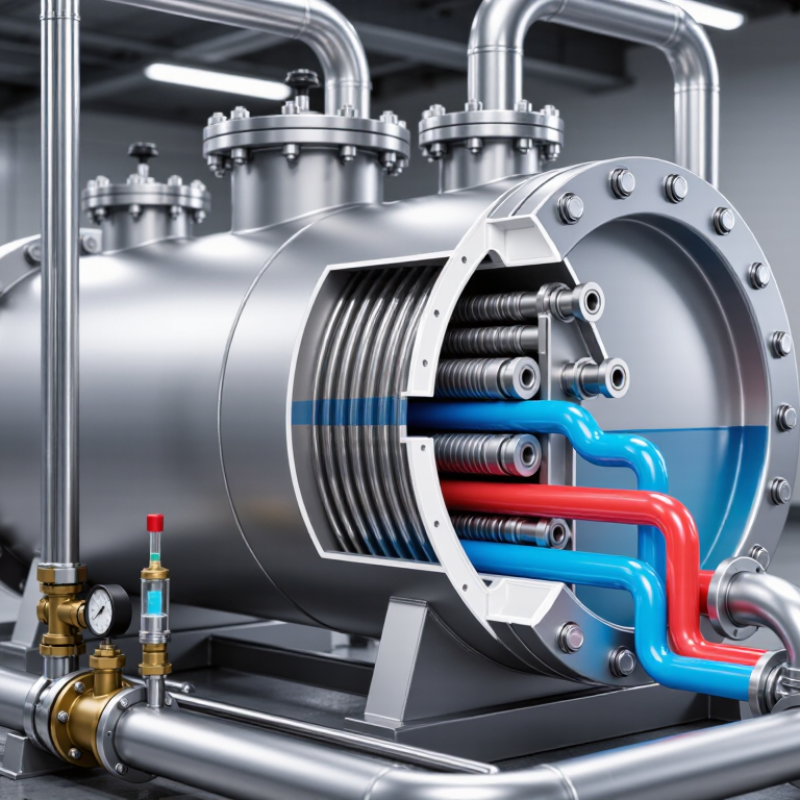
Table of Contents [Hide]
Water Chiller Evaporator: Definition and Core Purpose
A water chiller evaporator is the heat exchanger where refrigerant absorbs heat from circulating water. Its core purpose is simple: remove unwanted heat from the water loop. The cooled water then travels to air-handling units, process equipment, or other cooling loads. In many systems, water enters near 12°C and leaves near 7°C. The exact temperatures depend on design and operating conditions.
Inside the evaporator, low-pressure refrigerant changes from liquid into vapor. This phase change requires heat, which comes from the passing water. A shell-and-tube evaporator uses separate passages for water and refrigerant. A plate design uses thin, corrugated plates instead. Neither fluid should mix. It is not a storage tank.
Reliable operation depends on steady water flow, clean heat-transfer surfaces, and accurate temperature sensors. Fouling can create an invisible insulating layer, reducing cooling capacity while increasing energy use. Low flow may cause freezing risks, especially when leaving-water temperature is set too low. Small errors matter. During commissioning, technicians often compare entering and leaving temperatures, pressure readings, and actual flow. This practical check can reveal problems that a control screen misses.
The evaporator also connects the cooling load to the refrigeration cycle. After absorbing heat, the refrigerant vapor moves toward the compressor. If the evaporator is oversized, undersized, dirty, or poorly controlled, the entire chiller may perform inefficiently. A careful design review should consider fluid quality, pressure drop, maintenance access, and seasonal load changes. Some assumptions still fail in real buildings. Door openings, unstable flow, and neglected strainers can change performance quickly.
Contact Us
Phone
Toll Free: 1-800-796-2344
OH: 513 204 5837
PA: 215-281-9180
support@site_367d8ed1-a876-442b-a1d7-b1fc1cf4ed19