Aegis provides affordable, low power Wi-Fi sensor network solutions that make a ubiquitous sensing world come alive and a full line of controlled temperature cabinets. Laboratory, Pharmacy and Chromatography refrigerators and freezers which are designed to meet the dimensional and temperature requirements of the scientific community.

What Are Bamboo Dishes Made Of?
Bamboo Dishes may look like simple pieces of pale, finely grained plant material. Their composition, however, can vary considerably. Some are carved or laminated from bamboo strips; others use bamboo powder or fiber combined with binders. A product labeled “bamboo” may therefore contain more than bamboo. Check the material description, care instructions, and food-contact information before choosing a plate or bowl.
The market is growing, but broad figures need context. Grand View Research estimated the global bamboo market at approximately $68.8 billion in 2022, with projected growth through 2030. That report covers many bamboo products, not dishes alone. It signals wider commercial interest, not proof that every bamboo tableware item has the same makeup or environmental impact. That distinction matters.
Bamboo researcher Dr. Walter Liese has described bamboo as “a grass, not a tree.” This botanical distinction helps explain its rapid regrowth, but it does not tell us what a finished dish contains. Look closely. A smooth, glossy surface may come from a coating or binder, while visible grain can suggest a different construction. Appearance alone is not enough. Even product labels can be frustratingly vague. A useful guide should separate solid bamboo, laminated pieces, and molded composites, then explain what each material means for everyday use. The details are small, but they belong in the conversation. The goal is not to treat bamboo as automatically better; it is to understand what your dishes are actually made of.
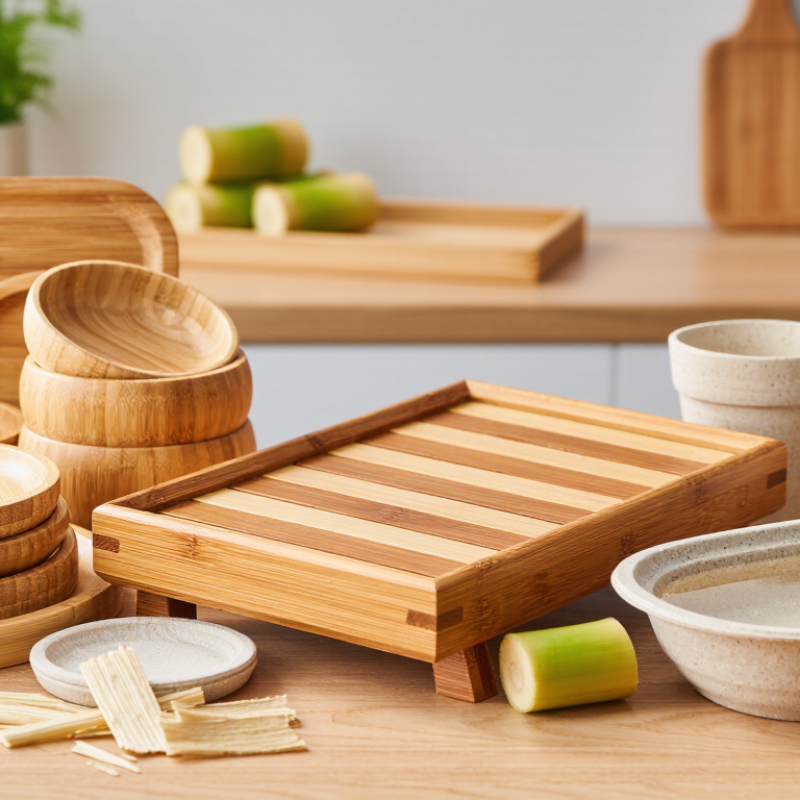
Table of Contents [Hide]
Bamboo Species and Plant Parts Used in Bamboo Dishes
Bamboo dishes can be made from different species and plant parts, so the word “bamboo” does not describe one exact material. Moso bamboo, Phyllostachys edulis, is commonly used because its tall, strong culms provide substantial material. In other regions, manufacturers may use locally available species. The choice depends on supply, culm size, and the dish-making process.
The main part used is the culm, or hollow stem. Its woody walls can be cut into strips, layered, and pressed into shapes such as bowls or trays. For molded dishes, culms may instead be broken down into fibers or pulp. These fibers are combined with other ingredients and formed under heat and pressure. The outer culm surface may remain visible in some products, while processed pulp usually has a smoother, more uniform appearance. Small details matter.
Nodes—the raised joints along a culm—can affect how the stem is cut and processed, though they are not typically the feature that gives a finished dish its strength. Leaves and shoots are generally not the main structural material in rigid bamboo dishware. Still, product labels can be vague. “Bamboo” may mean solid strips, bamboo pulp, or a composite, and those materials are not interchangeable. A close look at the stated ingredients can reveal what the dish actually contains.
Contact Us
Phone
Toll Free: 1-800-796-2344
OH: 513 204 5837
PA: 215-281-9180
support@site_367d8ed1-a876-442b-a1d7-b1fc1cf4ed19