Aegis provides affordable, low power Wi-Fi sensor network solutions that make a ubiquitous sensing world come alive and a full line of controlled temperature cabinets. Laboratory, Pharmacy and Chromatography refrigerators and freezers which are designed to meet the dimensional and temperature requirements of the scientific community.

Why Are Zebra Window Blinds So Popular?
Zebra Window Blinds have moved from a specialist furnishing choice into mainstream interior design. Their appeal is practical: alternating sheer and opaque fabric panels allow users to soften daylight, improve privacy, and control glare without fully darkening a room. A hand-operated chain or motorized control can shift the stripes gradually, like adjusting a camera lens. Small change, noticeable comfort.
Industry data supports the wider demand for adaptable window coverings. Grand View Research’s Window Covering Market report identifies rising interest in light control, energy efficiency, and smart-home integration through 2030. Mordor Intelligence also reports continued growth in the global blinds and shades market, driven by residential renovation and connected-home technologies. These reports usually combine curtains, shades, shutters, and blinds. They do not measure Zebra Window Blinds separately, so their figures require careful interpretation.
From professional installation experience, fabric quality often determines the final result. Dense blackout bands can support bedroom privacy, while open sheer bands maintain a brighter daytime atmosphere. Correct measurements matter too. A few millimeters can create uneven edges, visible gaps, or difficult operation. The U.S. Department of Energy notes that window treatments can influence solar heat gain, although performance depends on glass, orientation, climate, and installation.
That is the less glamorous truth. Zebra blinds are not automatically energy-saving. Their popularity comes from balanced functionality, visual simplicity, and flexible control. As homes become brighter, smaller, and more technology-oriented, this combination explains why the product continues attracting homeowners, designers, and property developers.
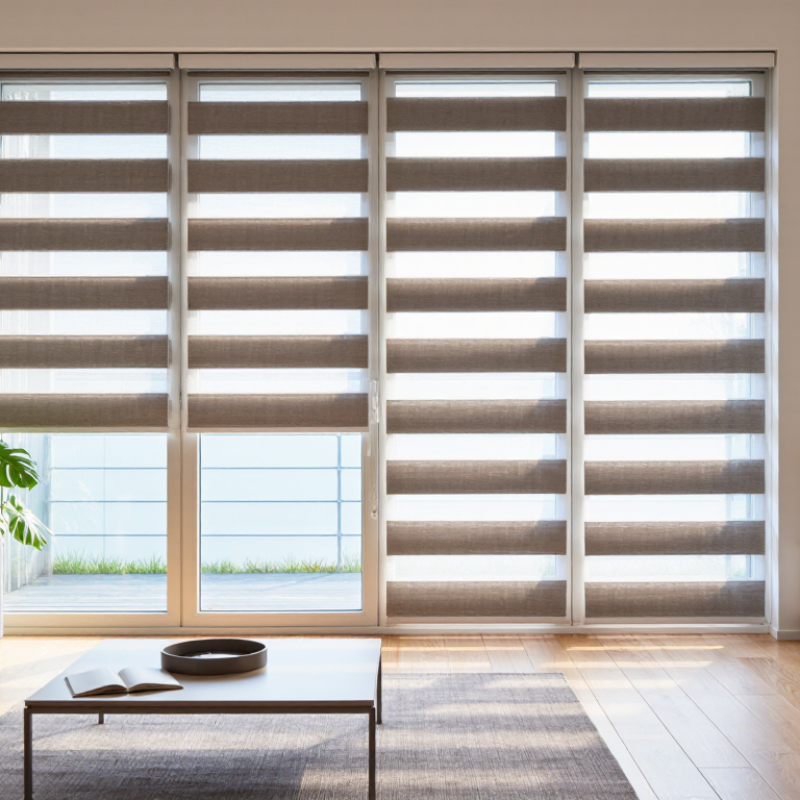
Table of Contents [Hide]
What Are Zebra Window Blinds?
Zebra window blinds are dual-layer shades made from alternating bands of sheer and opaque fabric. The bands slide across each other as the blind moves. This creates three practical settings: filtered daylight, partial privacy, or stronger light control. The idea is simple. Their flexibility explains much of their popularity.
In a sun-facing room, the sheer bands soften glare while preserving a view outside. Aligning the solid bands creates deeper privacy without fully darkening the room.
According to the U.S. Department of Energy’s Energy Saver guidance, about 76% of sunlight reaching standard double-pane windows can enter as heat during summer. Zebra blinds may reduce that exposure, but performance depends on fabric color, window direction, gaps, and installation quality. They are not magic.
The International Energy Agency reports that buildings account for roughly 30% of global final energy consumption. This makes daylight and solar control relevant design decisions, not merely decorative choices.
Professional measurement matters.
A narrow side gap can admit sharp morning light, while a loose fabric panel may look uneven. Industry energy-rating methods, including those used by the Attachments Energy Rating Council, evaluate window coverings under controlled conditions rather than promising identical savings in every home. That distinction is important. A zebra blind can improve comfort, but it cannot replace suitable glazing, ventilation, or thoughtful room design.
Contact Us
Phone
Toll Free: 1-800-796-2344
OH: 513 204 5837
PA: 215-281-9180
support@site_367d8ed1-a876-442b-a1d7-b1fc1cf4ed19