Aegis provides affordable, low power Wi-Fi sensor network solutions that make a ubiquitous sensing world come alive and a full line of controlled temperature cabinets. Laboratory, Pharmacy and Chromatography refrigerators and freezers which are designed to meet the dimensional and temperature requirements of the scientific community.

Why Choose Cup Paper Sheets for Paper Cup Manufacturing?
Choosing the right material is a practical decision in paper cup manufacturing. Cup Paper Sheet stock must feed smoothly, hold its shape, and support reliable side-seam and bottom sealing. A sheet that is too soft may buckle during forming. One that is too stiff can create feeding problems or uneven seams. The difference can appear small on a specification sheet, yet become obvious on a production line.
Manufacturers typically compare paper weight, stiffness, surface quality, and coating compatibility with their cup-forming equipment. These details influence how blanks cut, fold, and seal. They also affect the cup’s feel in the hand. For hot drinks, the paper structure and lining must suit the intended use and the supplier’s documented specifications. Food-contact suitability should be verified through current technical information, not guessed from appearance. Ask for sample sheets and test them on the actual machine. That step takes time.
Good material selection can help reduce jams, weak seams, and avoidable waste, but it is not a cure-all. Machine settings, storage conditions, and operator handling matter too. Paper kept in a damp room may behave differently from paper stored in a dry, controlled space. Even experienced teams can overlook that. There is no single sheet that fits every cup size, production speed, or end use. Comparing specifications with real forming trials gives buyers a clearer basis for choosing a dependable Cup Paper Sheet. Still, test results deserve review; one successful run does not prove every batch will perform the same.
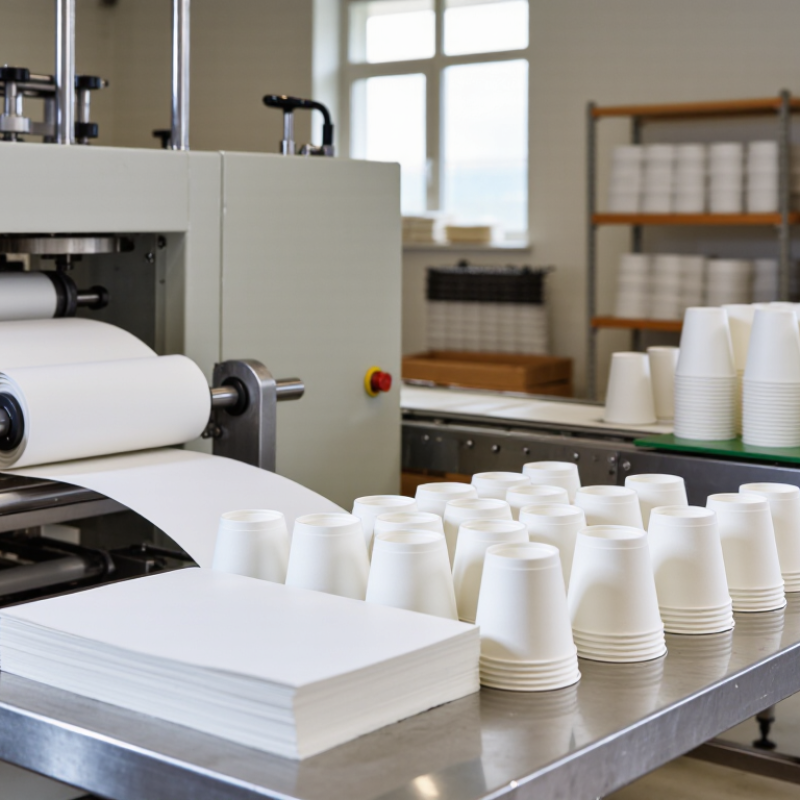
Table of Contents [Hide]
What Cup Paper Sheets Are and How They Are Made
Cup paper sheets are flat paperboard blanks used to form cup walls and bases. They arrive as rolls or pre-cut sheets, depending on the converting equipment. Many have a thin polymer or water-based barrier to help resist leaks and softening. The board adds stiffness; the coating limits liquid contact. Details matter.
Production begins with paper pulp, which is formed into board, dried, and calendered to create an even surface and consistent thickness. A moisture barrier is then applied and dried or cured under controlled conditions. The coated stock may be printed before die-cutting into fan-shaped wall blanks and circular base pieces. During cup forming, heat and pressure seal the side seam, and the base is fitted into place. Moisture, coating weight, and sealing temperature can all affect seam strength. Results are not always perfect.
Tips: Store sheets flat in a dry area, away from heat and humidity. Before a full run, test a small batch for curling, clean cuts, and leaks. A quick sample check can catch setup issues, though it cannot replace routine quality checks.
Contact Us
Phone
Toll Free: 1-800-796-2344
OH: 513 204 5837
PA: 215-281-9180
support@site_367d8ed1-a876-442b-a1d7-b1fc1cf4ed19