Aegis provides affordable, low power Wi-Fi sensor network solutions that make a ubiquitous sensing world come alive and a full line of controlled temperature cabinets. Laboratory, Pharmacy and Chromatography refrigerators and freezers which are designed to meet the dimensional and temperature requirements of the scientific community.

Why Choose a PEEK Interference Screw?
Anterior cruciate ligament reconstruction depends on stable graft fixation while bone tunnels heal. The Peek Interference Screw is one option: it compresses the graft against the tunnel wall, creating immediate mechanical fixation. Polyether ether ketone (PEEK) is radiolucent, so it generally creates less imaging obstruction than metal. That can help clinicians assess tunnel position and surrounding bone on follow-up images.
Material choice deserves careful attention. The American Academy of Orthopaedic Surgeons’ 2022 Clinical Practice Guideline for ACL injuries discusses reconstruction and graft considerations, but does not endorse PEEK screws as universally superior. That distinction matters. A screw’s performance also depends on graft type, tunnel placement, bone quality, surgical technique, and the patient’s activity demands. PEEK does not resorb like some bioabsorbable materials, and its presence may remain relevant during later imaging or revision planning.
The practical appeal is clear. A surgeon can secure a soft-tissue graft without leaving a metal implant that obscures radiographs. Still, radiolucency is not proof of better healing, and material properties alone cannot predict an individual result. Evidence comparing fixation devices can be difficult to interpret because studies use different grafts, techniques, and follow-up periods. No implant is perfect. Patients should ask their surgeon why PEEK fits their specific reconstruction, what alternatives are available, and which complications require attention during recovery. The best choice is the one supported by the clinical situation—not by material claims alone.
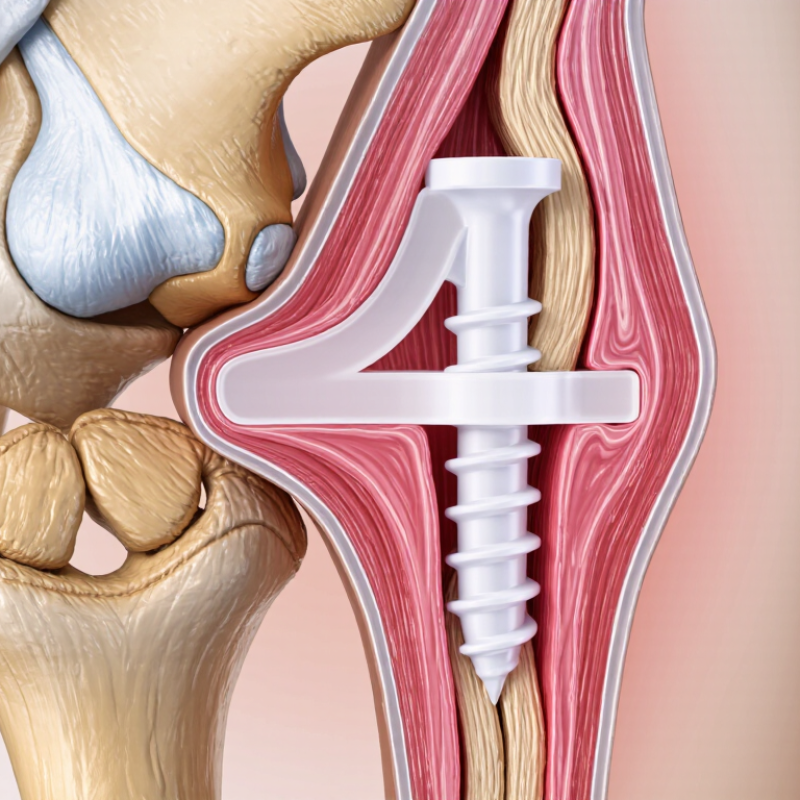
Table of Contents [Hide]
Definition and Design of PEEK Interference Screws
A PEEK interference screw is a non-absorbable implant used to secure a tendon or ligament graft inside a prepared bone tunnel. Its threads engage the tunnel wall and press the graft against surrounding bone. This creates fixation through compression, rather than relying on a plate or external hardware. The screw’s design includes a central core, thread depth and pitch, and often a tapered tip. These details affect insertion and how force is distributed. Some models are cannulated for guidewire placement; others are solid. Small differences matter.
PEEK, or polyether ether ketone, is a strong, radiolucent polymer. Kurtz and Devine’s peer-reviewed review in Biomaterials (2007) reports typical PEEK elastic modulus near 3.6 GPa and tensile strength around 90–100 MPa. These values help explain its use in load-bearing implants, but they do not predict how one screw performs in every tunnel or graft. The material is visible less clearly on standard X-rays than metal, which can aid assessment of surrounding bone. Still, radiolucent does not mean invisible in every imaging method. Screw diameter, tunnel fit, bone quality, and insertion technique all influence fixation. The design is not the whole story.
Contact Us
Phone
Toll Free: 1-800-796-2344
OH: 513 204 5837
PA: 215-281-9180
support@site_367d8ed1-a876-442b-a1d7-b1fc1cf4ed19