Aegis provides affordable, low power Wi-Fi sensor network solutions that make a ubiquitous sensing world come alive and a full line of controlled temperature cabinets. Laboratory, Pharmacy and Chromatography refrigerators and freezers which are designed to meet the dimensional and temperature requirements of the scientific community.

Why Is a Clean Room Important for Global Manufacturers?
Global manufacturers depend on controlled environments to protect products from invisible threats. A single fiber, skin particle, or unstable air current can damage a sensor, contaminate medicine, or weaken a precision component. This is why a Clean Room matters beyond the factory floor. It protects quality at the moment products are assembled, tested, and packaged.
William Whyte, a widely cited cleanroom specialist, wrote, “Cleanroom technology is not a science, it is a way of life.” His words remain practical. A reliable Clean Room requires filtered air, monitored pressure, disciplined gowning, and regular cleaning. It also requires trained people who understand why each movement matters. An operator reaching across an open tray may create more risk than an imperfect cleaning schedule. Small actions leave evidence.
The benefits extend across international production networks. Consistent particle control helps manufacturers reduce defects, compare output between facilities, and meet demanding customer expectations. Environmental monitoring records can also support credible audits and process improvements. Still, a certified room is not automatically a perfect room. Equipment can drift. Procedures can become routine and careless. Even experienced teams make mistakes. That uncomfortable fact deserves attention.
Effective manufacturers review particle counts, temperature, humidity, pressure differences, and personnel behavior together. They investigate unusual readings instead of hiding them. The strongest Clean Room programs combine engineering controls with honest learning. This approach supports safer products, more stable production, and trust across borders. Cleanliness is not merely a facility feature. It is a daily manufacturing responsibility.
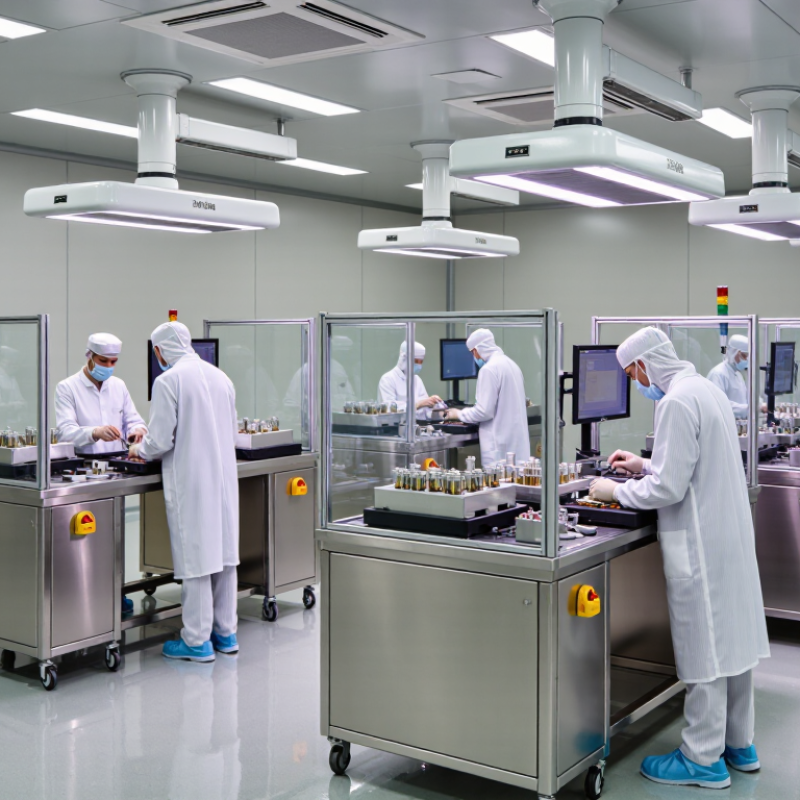
Table of Contents [Hide]
Define Cleanrooms: ISO 14644-1 Limits for 0.1–5 μm Particles
Why Is a Clean Room Important for Global Manufacturers?
A cleanroom is a controlled environment that limits airborne particles, temperature, humidity, and pressure. Particle control protects sensitive products from contamination and reduces manufacturing variation. Clean does not mean particle-free. It means measured and controlled.
ISO 14644-1 classifies air cleanliness by particle concentration. The standard covers particles from 0.1 to 5 micrometers. A micrometer is one millionth of a meter.
ISO Class 5 allows up to 100,000 particles at 0.1 μm per cubic meter. At 0.5 μm, the limit drops to 3,520 particles.
For ISO Class 7, the limits are 10,000,000 particles at 0.1 μm and 352,000 at 0.5 μm.
ISO Class 8 permits 100,000,000 particles at 0.1 μm and 3,520,000 at 0.5 μm.
These figures apply to defined sampling conditions, not casual visual checks.
Measurements require calibrated particle counters, suitable sampling locations, and documented occupancy states. Particles matter. Operators, clothing, packaging, and door movement can quickly change results.
A room may pass one test and fail during active production. That difference deserves attention.
Some smaller ISO classes also treat 5 μm limits as not applicable because reliable counting becomes difficult. Manufacturers should therefore review the standard, risk assessment, airflow design, and monitoring data together.
A lower class number sounds safer, but it may not address every product risk. That is where practical judgment remains necessary.
Contact Us
Phone
Toll Free: 1-800-796-2344
OH: 513 204 5837
PA: 215-281-9180
support@site_367d8ed1-a876-442b-a1d7-b1fc1cf4ed19