Aegis provides affordable, low power Wi-Fi sensor network solutions that make a ubiquitous sensing world come alive and a full line of controlled temperature cabinets. Laboratory, Pharmacy and Chromatography refrigerators and freezers which are designed to meet the dimensional and temperature requirements of the scientific community.

Why Are Produce Clamshells Important for Global Buyers?
Produce Clamshells are no longer simple plastic containers. For global buyers, they influence food safety, shelf life, transport efficiency, retail presentation, and waste reduction. That responsibility becomes clearer against global supply-chain data. The FAO estimates that 14% of food is lost between harvest and retail, while UNEP reported 1.05 billion tonnes of food waste in 2022. Better packaging cannot solve every loss, but it can reduce bruising, contamination risks, moisture damage, and premature deterioration.
The details matter. A vented clamshell can help strawberries breathe during refrigerated transport. A secure hinge can prevent berries from spilling across a distribution pallet. Clear visibility also lets buyers inspect mold, condensation, and fruit condition before purchase. Trevor Suslow, a produce-safety specialist associated with UC Davis, emphasizes: “Packaging supports safety; it does not replace sanitation, cooling, or careful handling.” That warning deserves attention. Produce Clamshells work only within a disciplined cold chain.
Industry reports reinforce this practical view. The PMMI report, Fresh Produce Packaging Trends, identifies convenience, product protection, automation, and sustainability as major market priorities. Meanwhile, the Ellen MacArthur Foundation continues to encourage packaging systems designed for circularity and material efficiency. Yet global buyers face an uncomfortable trade-off. Thinner materials may reduce resin use, but they can also increase damage. Recycled content may improve sustainability, but supply consistency and food-contact compliance still require verification. A clamshell is useful, not perfect. Its value depends on measured performance, responsible materials, and honest communication throughout the supply chain.
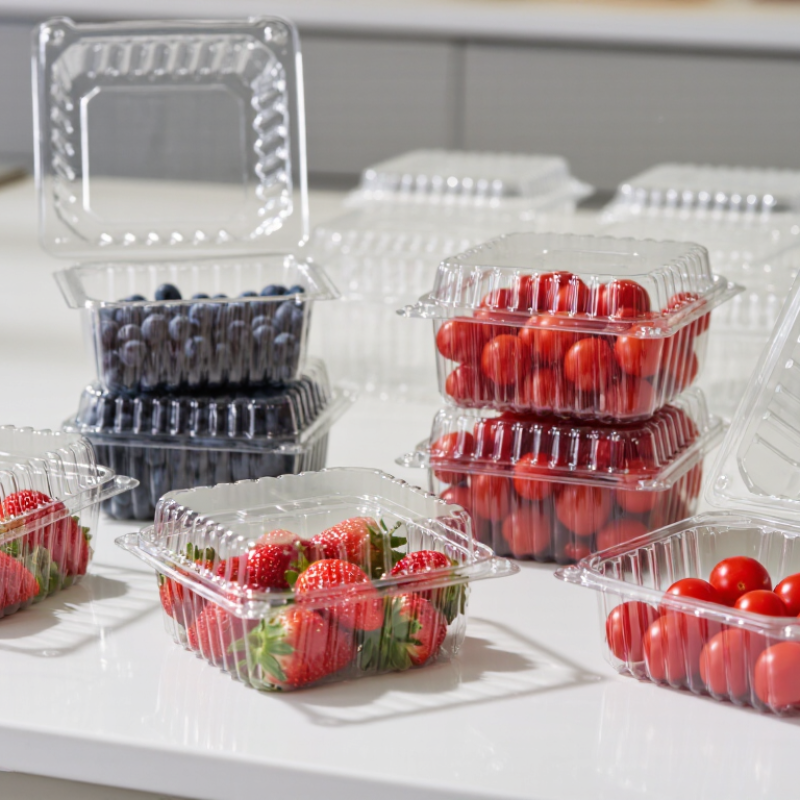
Table of Contents [Hide]
What Produce Clamshells Are and How They Work
Produce clamshells are hinged containers made from clear plastic or fiber-based materials. They hold berries, grapes, tomatoes, and delicate leafy produce. Their rigid walls reduce crushing during stacking and transport. The clear lid also lets buyers inspect color, size, and visible defects without opening the pack.
Small vents help manage moisture. Too much condensation can accelerate mold. Too little humidity can dry the product. Packaging specialists must match vent design with produce type, cooling speed, and shipment length. The Food and Agriculture Organization reported that 13.2% of food was lost between harvest and retail in 2021. A well-designed clamshell may reduce handling damage, but it cannot correct poor harvesting or weak cold-chain control. It is not a magic fix.
Tips: Global buyers should request compression, drop, seal, and ventilation data. Check whether the pack survives pallet stacking and repeated temperature changes. Confirm food-contact compliance for each destination market. Also review end-of-life options. The United Nations Environment Programme reported 1.05 billion tonnes of food waste in 2022, including retail and household losses. Packaging can protect food, yet excessive material may create another burden. A practical specification should balance product protection, shelf visibility, recyclability, and total pack weight. Field feedback matters. Sometimes the “best” clamshell fails in humid warehouses.
Contact Us
Phone
Toll Free: 1-800-796-2344
OH: 513 204 5837
PA: 215-281-9180
support@site_367d8ed1-a876-442b-a1d7-b1fc1cf4ed19