Aegis provides affordable, low power Wi-Fi sensor network solutions that make a ubiquitous sensing world come alive and a full line of controlled temperature cabinets. Laboratory, Pharmacy and Chromatography refrigerators and freezers which are designed to meet the dimensional and temperature requirements of the scientific community.

Top Portable Refrigerator Freezer for Global Buyers?
Choosing a portable refrigerator freezer for global buyers requires more than comparing capacity and price. A reliable unit must perform in hot camps, crowded vehicles, and airport transfers. Buyers often focus on cooling speed. They sometimes overlook insulation, battery protection, compressor noise, and service access. These details decide whether food stays safely chilled during a long roadside stop. Real-world use exposes weaknesses that product pages may hide. Dust matters. So does humidity.
This guide examines practical features through an evidence-led lens. It considers tested temperature stability, energy use, internal layout, lid design, handles, wheels, and control options. A strong model should cool consistently without draining a vehicle battery overnight. It should also tolerate vibration and repeated loading. Independent specifications, manufacturer documentation, and user experience all deserve attention. Yet reviews are not perfect. Test conditions vary, and one impressive result cannot represent every climate. That limitation should remain visible.
Global buyers also face different power systems, plug formats, warranty terms, and replacement-part availability. A compressor model suitable for a family SUV may feel excessive on a small boat. Conversely, a compact cooler may struggle with frozen goods in tropical heat. The best choice depends on trip length, storage needs, ambient temperature, and available power. This introduction creates a practical path for comparing leading options fairly. It favors verified performance over polished claims. Small compromises still exist. Knowing them makes the final purchase more dependable.
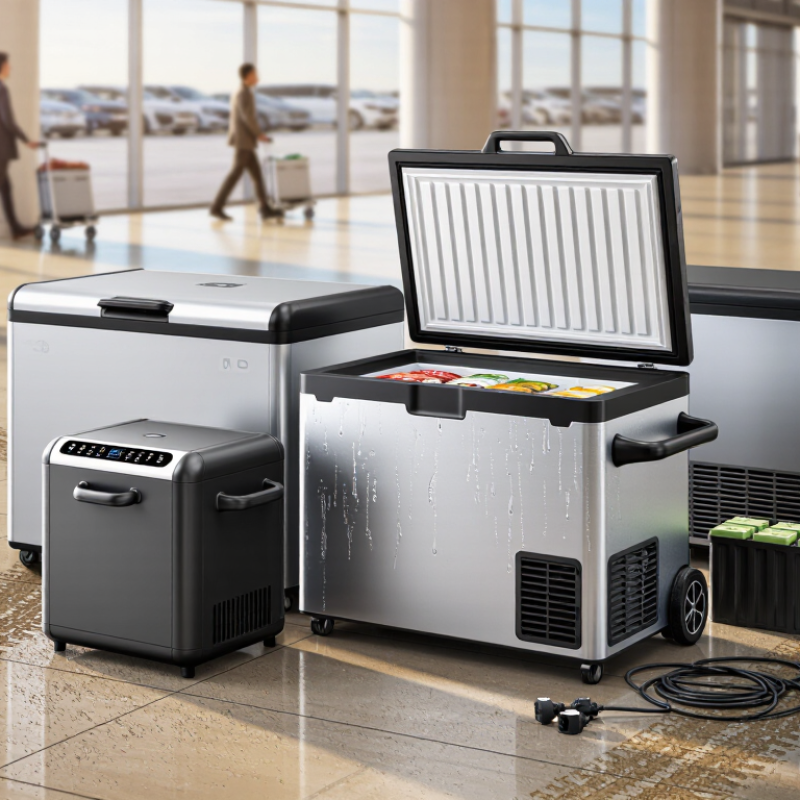
Table of Contents
[Hide]
What Is a Portable Refrigerator Freezer and How Does It Work?
A portable refrigerator freezer is a compact cooling appliance designed for travel, camping, trucks, boats, and emergency storage. Unlike an ice cooler, it uses electricity to remove heat continuously. Most models use a compressor, refrigerant, condenser, evaporator, and thermostat. The compressor pressurizes the refrigerant. Heat then moves outside the cabinet, while cold air remains inside.
Many units accept 12V or 24V vehicle power and standard household electricity. Some use thermoelectric systems, but compressors usually provide stronger cooling and freezing performance. A 2024 Grand View Research market analysis projects steady growth in portable refrigerator demand through 2030, with an annual growth rate of roughly 7%. This reflects practical use, not just outdoor trends. The U.S. Department of Energy also evaluates refrigeration efficiency through measured energy consumption, usually reported in kilowatt-hours. Portable users should apply the same logic.
Tips: Pre-cool food before loading. Leave airflow around the vents. Set the temperature with a thermometer, not only the digital display. A crowded cabinet cools unevenly. Small details matter.
In real use, ambient temperature, cable length, battery condition, and lid opening frequency change performance. A unit rated for freezing may struggle under direct summer sun. That rating can be technically correct, yet incomplete. I have found that a slightly larger capacity often works better than filling a small cabinet tightly. Still, bigger units consume more space and energy. This trade-off deserves honest checking before purchase.
Top Portable Refrigerator Freezer for Global Buyers? - What Is a Portable Refrigerator Freezer and How Does It Work?
| Evaluation Dimension | Typical Data or Specification | What It Means for Global Buyers |
|---|---|---|
| Product Definition | A compact electrically powered appliance that cools or freezes food, beverages, medicine, and other temperature-sensitive items. | It provides refrigeration away from a household power outlet, making it suitable for road trips, camping, boating, delivery, and emergency backup. |
| Cooling Technology | Most high-performance units use a vapor-compression compressor system. | Compressor cooling generally reaches lower temperatures and performs more reliably in warm outdoor conditions than thermoelectric cooling. |
| Temperature Range | Common operating range: approximately 20°C to -20°C; some freezer-oriented models can reach about -25°C. | A unit capable of temperatures below 0°C can function as a freezer, while adjustable settings support chilled food and beverages. |
| Capacity Options | Typical capacities range from approximately 10 L to 60 L. Larger dual-compartment models may exceed 70 L. | Small capacities suit personal travel, medium capacities suit family use, and larger capacities are better for extended trips or commercial transport. |
| Power Input | Common inputs include 12/24 V DC for vehicles and 100–240 V AC through an adapter. | Dual-voltage compatibility allows the appliance to operate in cars, trucks, boats, campsites, homes, and different electrical markets. |
| Energy Consumption | Many efficient compressor units are rated around 40–80 W while the compressor is running; actual daily use varies with temperature and insulation. | Buyers should compare watt-hours per day rather than only the rated wattage because ambient temperature, loading, and temperature settings affect total energy use. |
| Battery Protection | Common protection settings disconnect the appliance when vehicle voltage becomes too low. | Low-voltage protection helps reduce the risk of draining a vehicle starter battery, especially during extended parking. |
| Cooling Performance | A well-insulated compressor unit may cool from room temperature to refrigerator temperature in roughly 15–30 minutes under favorable conditions. | Pre-cooling the appliance and its contents improves startup performance and reduces battery consumption. |
| Single or Dual Zone | Single-zone models use one temperature compartment; dual-zone models provide two independently controlled sections. | Dual-zone operation can keep frozen food and chilled beverages separated, but it usually increases weight, size, and energy demand. |
| Insulation | Thick polymer foam insulation and a tight-fitting lid are commonly used to reduce heat transfer. | Better insulation helps maintain temperature, lowers compressor running time, and improves battery endurance. |
| Noise Level | Typical compressor-based units produce approximately 35–50 dB during operation, depending on design and operating conditions. | Lower noise is preferable for sleeping areas, cabins, hotel rooms, and quiet campsites. |
| Temperature Control | Digital controls commonly allow one-degree temperature adjustments, while some models include a mobile application. | Precise controls help protect perishable goods and make it easier to monitor conditions during travel. |
| Construction Materials | Common materials include impact-resistant plastic, insulated inner walls, corrosion-resistant hardware, and metal or reinforced polymer handles. | Outdoor buyers should prioritize impact resistance, secure hinges, washable interiors, and protection against moisture and dust. |
| Portability Features | Common features include carrying handles, drain plugs, removable baskets, tie-down points, and optional wheels. | The best configuration depends on whether the unit will be carried by hand, moved across a campsite, or secured in a vehicle. |
| Vehicle Compatibility | Designed for 12 V or 24 V vehicle systems, with a suitable cable and fuse protection. | Before purchase, buyers should verify socket type, cable length, fuse rating, mounting space, and the vehicle's available electrical capacity. |
| Best Applications | Camping, overlanding, road travel, marine use, outdoor events, food delivery, medical transport, and emergency preparedness. | Application requirements determine the ideal capacity, temperature range, power source, portability, and durability level. |
| Key Selection Criteria | Cooling range, internal capacity, power compatibility, energy efficiency, noise, insulation, warranty support, and safety certifications. | A balanced evaluation is more reliable than choosing by capacity or purchase price alone. |
| How It Works | The compressor circulates refrigerant through a closed loop. The refrigerant absorbs heat inside the cabinet and releases it through the external condenser. | This heat-transfer process lowers the internal temperature without requiring ice, while the thermostat cycles the compressor to maintain the selected setting. |
Related Posts
-
Top Portable Refrigerator Freezer Buying Guide?
-
How to Choose a Portable Refrigerator Freezer in 2026?
-

China Top 10 Portable Fridge Suppliers for Global Buyers?
-
What is a 4 cu ft freezer and How Can It Benefit Your Home?
-
Best Fridge Temperature Monitor for Your Food Safety Needs?
-

10 Essential Tips for Choosing a Large Fridge for Your Home?
Contact Us
Phone
Toll Free: 1-800-796-2344
OH: 513 204 5837
PA: 215-281-9180
support@site_367d8ed1-a876-442b-a1d7-b1fc1cf4ed19