Aegis provides affordable, low power Wi-Fi sensor network solutions that make a ubiquitous sensing world come alive and a full line of controlled temperature cabinets. Laboratory, Pharmacy and Chromatography refrigerators and freezers which are designed to meet the dimensional and temperature requirements of the scientific community.

China Best Freezer Temperature Monitor Buying Guide
Choosing the right freezer temperature monitor in China requires more than comparing prices and screen sizes. A reliable device should protect frozen food, medicines, laboratory samples, or other temperature-sensitive goods during everyday storage. Small temperature changes can remain invisible until quality suffers. A useful monitor records them clearly.
This China Best Freezer Temperature Monitor Buying Guide examines sensor accuracy, alarm performance, probe design, data logging, battery life, and wireless options. It also considers factory experience, quality-control procedures, calibration records, and after-sales support. These details matter when evaluating manufacturers, wholesalers, and OEM suppliers. A product may look impressive online but perform differently inside a crowded freezer at minus 20 degrees Celsius.
Look for readable alerts, secure probe placement, and a stable signal through insulated doors. Check whether the monitor stores historical readings and exports them in a practical format. Ask suppliers about testing methods, operating ranges, waterproof protection, and replacement parts. No device is perfect. That matters.
A low-cost model may suit a household freezer, while a warehouse needs stronger alarms and dependable records. Real conditions can expose weaknesses that product photos hide. Condensation, thick insulation, weak batteries, and delayed notifications all deserve attention. This guide offers a careful framework for comparing Chinese suppliers and selecting a freezer temperature monitor that fits your environment, budget, and monitoring requirements. Expect useful options, but verify every important claim before purchasing.
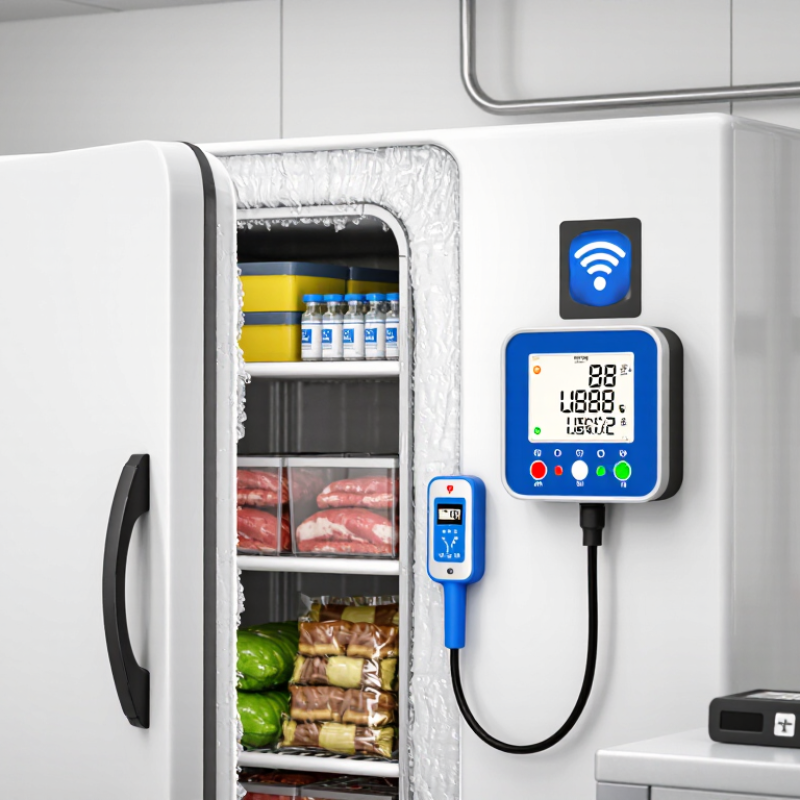
Table of Contents
[Hide]
What Is a Freezer Temperature Monitor and Why Is It Important?
A freezer temperature monitor is a sensor-based device that measures and records the air temperature inside a freezer.
Unlike a single manual reading, it can track changes throughout the day. Many models also provide alerts when temperatures rise above a chosen limit. This matters during power failures, door-opening periods, or equipment problems. A small display may show the current reading, while stored data can reveal a slow temperature increase that people might miss.
Stable temperatures help protect frozen food quality and reduce avoidable waste. However, a monitor does not replace proper freezer maintenance. Its sensor needs suitable placement, away from the door and direct airflow.
Calibration also matters. An inaccurate reading can create false confidence. For dependable results, compare the monitor with a verified reference thermometer and inspect its battery regularly. No device is perfect. Even careful users may overlook condensation, weak signals, or a poorly positioned sensor.
Tips:
Choose a monitor with clear alerts, readable data, and a history function. Place the sensor near stored food, not against the freezer wall. Test the alarm occasionally. Keep a simple temperature log during the first week. This can expose unusual patterns, although one week may not represent every season. For commercial storage, select equipment suited to the required monitoring range and keep records for routine checks.
Related Posts
-
China Top 10 Fridge Temperature Monitor Manufacturers
-
Top Freezer Temperature Monitors to Keep Your Food Safe in 2025
-
2026 Best Freezer Temperature Monitor for Optimal Food Safety and Quality?
-
Best Fridge Temperature Monitor for Optimal Food Safety?
-
Top Refrigerator Freezers to Buy in 2026 for Global Buyers?
-
Best Portable Fridge for Your Global Sourcing Needs?
Contact Us
Phone
Toll Free: 1-800-796-2344
OH: 513 204 5837
PA: 215-281-9180
support@site_367d8ed1-a876-442b-a1d7-b1fc1cf4ed19