Aegis provides affordable, low power Wi-Fi sensor network solutions that make a ubiquitous sensing world come alive and a full line of controlled temperature cabinets. Laboratory, Pharmacy and Chromatography refrigerators and freezers which are designed to meet the dimensional and temperature requirements of the scientific community.

What Is a Refrigerator Cooler and How Does It Work?
A refrigerator cooler looks simple from the outside, yet its operation depends on carefully controlled heat movement. It does not create cold. Instead, it removes heat from the cabinet and releases that heat into the room. Dr. Ian Bell, a refrigeration-cycle researcher and developer of widely used thermodynamic tools, explains the basic principle clearly: “The evaporator absorbs heat; it does not manufacture cold.” This idea helps readers understand why the rear coils may feel warm.
Inside a refrigerator cooler, the compressor first squeezes the refrigerant into a high-pressure gas. The condenser then releases heat through coils near the back or underneath the appliance. As the refrigerant passes through the expansion device, its pressure drops sharply. It becomes colder. The evaporator, located inside the insulated cabinet, absorbs heat from food, shelves, and trapped air. A fan may circulate that chilled air, creating more even temperatures.
The cycle repeats continuously.
A thermostat or electronic sensor controls when the compressor runs. Door openings, warm groceries, blocked vents, and dusty coils can change its workload. A crowded shelf may also restrict airflow. That detail is easy to overlook. I once assumed a lower temperature setting always meant better cooling. It does not. It may increase energy use and dry certain foods.
This guide will examine each component, the cooling cycle, common efficiency problems, and practical maintenance. Some refrigerator cooler designs use fans, while others rely mainly on natural air movement. Their results can differ. Understanding those differences makes troubleshooting more accurate and less dependent on guesswork.
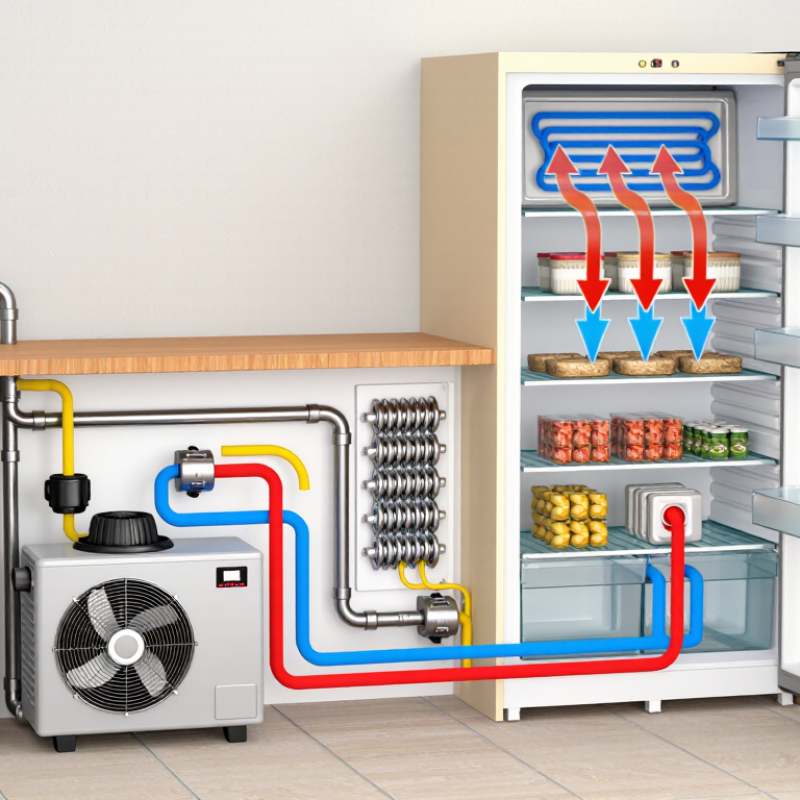
Table of Contents
[Hide]
What Is a Refrigerator Cooler?
A refrigerator cooler is the temperature-controlled space and cooling system that keeps food fresh. In everyday language, people may call the whole appliance a cooler. Technically, it is more than an insulated box. It uses an evaporator coil, compressor, condenser coil, refrigerant, thermostat, and airflow paths. Insulated walls slow heat from returning. Small detail, big effect.
When the interior becomes warmer than the selected setting, the thermostat signals the compressor to start. Refrigerant flows through the evaporator coil and absorbs heat from the cabinet air. The compressor raises the refrigerant’s pressure, while the condenser releases that heat outside. A fan may move air across the coils. This cycle repeats. It does not create cold; it transfers heat away. In practical use, blocked vents can create warm pockets between food containers. A loose door seal can also make the compressor run longer.
A refrigerator cooler works more reliably when shelves are not overcrowded and the door stays closed. Keeping a small thermometer inside gives better evidence than guessing from touch. A cold surface does not always mean safe, even cooling. Problems may involve frost, dust around the condenser, a damaged gasket, or a faulty sensor. Refrigerant issues need qualified service. I used to think louder operation always meant failure, but some noise is normal. Still, unusual clicking or continuous running deserves attention.
Related Posts
-
Top Freezer Temperature Monitors to Keep Your Food Safe in 2025
-
How to Set the Ideal Freezer Temperature for Optimal Food Storage?
-
What Is an Ultra Low Freezer and How Does It Work?
-

What is a Portable Refrigerator and How Does It Work?
-

10 Essential Tips for Choosing a Large Fridge for Your Home?
-
How to Choose a Portable Refrigerator Freezer in 2026?
Contact Us
Phone
Toll Free: 1-800-796-2344
OH: 513 204 5837
PA: 215-281-9180
support@site_367d8ed1-a876-442b-a1d7-b1fc1cf4ed19