What Is a 4 Cu Ft Freezer and How Much Does It Hold?
A 4 cu ft freezer is a compact appliance with four cubic feet of stated storage capacity—about 6,912 cubic inches. That figure describes interior volume, not the number of groceries it can hold. Shelves, baskets, wall thickness, and package shapes all reduce usable space. A neat row of frozen dinners fits differently from bulky bread bags or a whole chicken.
For a practical estimate, picture several grocery bags of frozen food, with room left for airflow and easy access. Exact capacity varies by model, so check the manufacturer’s usable-capacity details before buying. The U.S. Department of Energy’s appliance guidance also makes energy-use information useful when comparing models; a small freezer can still differ noticeably in annual electricity consumption. Check the actual label, not just the size.
Temperature matters, too. The USDA Food Safety and Inspection Service recommends keeping a freezer at 0°F (-18°C) for food quality and safety. A crowded unit may take longer to stabilize after loading, while an almost-empty one can feel wasteful for a small household. Neither situation has a perfect universal rule. A 4 cu ft freezer can suit an apartment, office, or backup-storage need, but the right fit depends on shopping habits, package sizes, and available floor space. Think of it as a useful buffer, not a miniature warehouse.
What a 4-Cubic-Foot Freezer Is
A 4-cubic-foot freezer has about four cubic feet of interior storage space. That measurement describes volume, not the number of pounds it can hold. In everyday terms, it is a compact appliance for keeping frozen food close at hand. It may suit a small household, a limited kitchen, or extra storage beside a larger refrigerator. Some models open from the top, while others have a front door and shelves. The shape changes how the space feels. It is compact.
Four cubic feet could hold several grocery bags of frozen items, such as vegetables, meals, and a few containers of meat. But the exact amount depends on packaging and the freezer’s layout. Thick insulation, baskets, shelves, and interior walls take up room. Capacity charts can make this sound more exact than it is. A tall box may fit neatly stacked packages, while a chest-style unit can be harder to organize. Measure the available floor space and door clearance before choosing one. Also consider whether the freezer needs room around it for ventilation. A small freezer still needs thoughtful placement.
What Is a 4 Cu Ft Freezer and How Much Does It Hold?
A 4-cubic-foot freezer has about 113 liters of interior volume. Using a common estimate of 35 pounds of frozen food per cubic foot, it may hold around 140 pounds. Actual capacity varies with packaging, food shape, and usable interior space.
How Its Capacity Relates to Interior Space
A 4 cu ft freezer contains about 113 liters of interior volume. That sounds roomy. But capacity is a volume measurement, not a promise that 113 liters of groceries will fit neatly. The U.S. Department of Energy’s residential refrigerator-freezer test procedure measures appliance volume, while NIST’s conversion guidance equates one cubic foot to about 28.3 liters. In practical terms, four cubic feet is roughly the space inside a box measuring 24 by 18 by 16 inches. Real freezer compartments are less tidy: baskets, wall insulation, and the compressor housing can interrupt that shape.
Not quite. Packaged food leaves gaps, and bulky containers waste space. A stack of flat frozen meals may use the interior better than irregular bags of vegetables, while a large roast can block access to items behind it. Check the listed usable dimensions, not just the capacity figure, and account for shelf height and basket placement. A planning estimate can still miss the mark; I would leave some open space rather than buy to the last inch. That makes it easier to see labels, move food, and avoid burying older packages under new ones.
How Much Food a 4-Cubic-Foot Freezer Can Hold
A 4-cubic-foot freezer offers about 113 liters of storage space. That measurement sounds generous, but it describes the compartment’s volume, not a guaranteed food weight. Baskets, shelves, cooling gaps, and bulky packaging all reduce usable room. A flat packet of chicken fits differently from a tall carton of frozen waffles. Small detail, big difference.
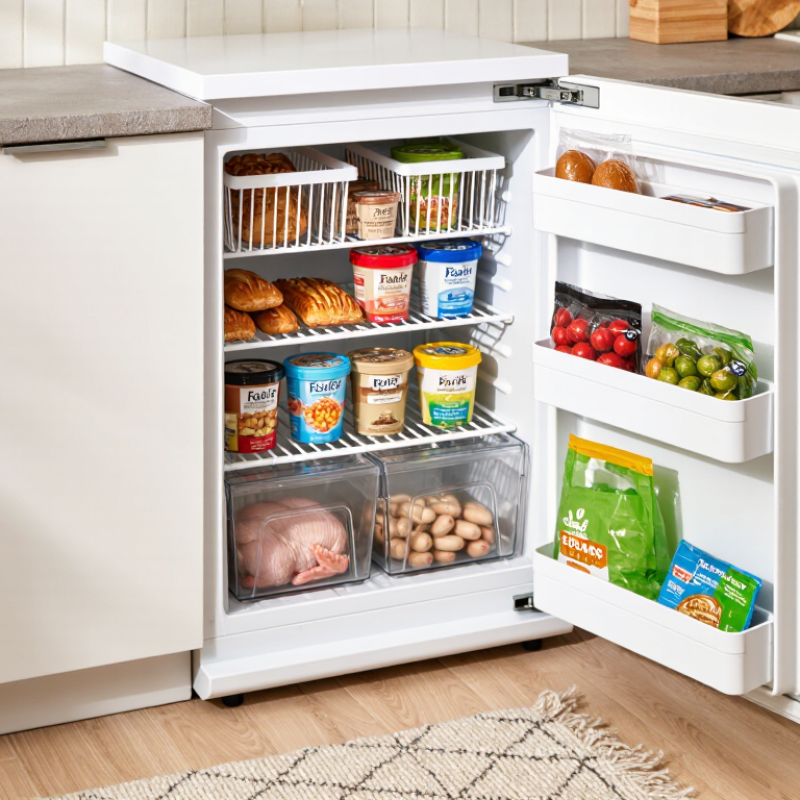
As a rough picture, you might store several bags of vegetables, two loaves of bread, a stack of flat meat packets, and a few meal containers. With compact packaging, there may be room for several dozen individually portioned meals; large boxes can cut that number quickly. Leave space around items so cold air can circulate, and avoid wedging food into every corner. A tightly packed freezer may hold more on paper, but it can be harder to organize and use. These examples are estimates, not a capacity promise. Check the freezer’s interior dimensions and measure your usual packages before buying. I’d also allow a little extra space for awkward shapes; that is easy to overlook.
Factors That Affect Its Usable Storage Capacity
A 4 cu ft freezer refers to its rated interior volume, but that number does not equal the space you can pack with food. Insulation, the compressor housing, and the shape of the inner walls reduce usable room. Two freezers with the same stated capacity may hold different amounts.
Layout matters, too. A basket or shelf keeps small items organized but takes up space. Large, uneven packages can leave awkward gaps, while flat containers stack neatly. A couple of frozen pizzas may fit easily; a bulky roast can block access to everything behind it. Leave some breathing room. Cold air needs to circulate, so packing food tightly against vents can affect temperature consistency. Frost buildup also narrows the available space, especially if the freezer is not defrosted when needed.
Packaging changes the estimate further. A box of individually wrapped portions uses more room than the portions placed in a compact container. Any storage estimate is imperfect; food shapes and container sizes vary. For a realistic check, measure the interior, note shelves and baskets, then test-fit the foods you buy most often.
What Is a 4 Cu Ft Freezer and How Much Does It Hold? — Factors That Affect Its Usable Storage Capacity
| Measure or Factor |
Typical Figure or Effect |
What It Means for Storage |
| Nominal capacity |
4 cubic feet |
The stated capacity is a volume measure; it does not indicate the freezer’s exterior dimensions or the exact number of packages it will hold. |
| Metric equivalent |
Approximately 113.3 liters |
Four cubic feet multiplied by 28.3168 liters per cubic foot gives about 113.3 liters. |
| Volume equivalent |
6,912 cubic inches |
This is the same nominal volume expressed in cubic inches (4 × 1,728). |
| Illustrative usable-space allowance |
About 3.2–3.6 cubic feet if 10–20% is difficult to pack efficiently |
This is a planning estimate, not a universal specification. The actual usable space depends on the freezer’s interior layout and the shape of the items stored. |
| Interior walls and cooling components |
Reduce or interrupt packable space |
Insulation, shelves, cooling surfaces, and other built-in components can limit how closely packages fit, even when the nominal capacity is the same. |
| Baskets and dividers |
Improve organization but occupy some interior volume |
Removable baskets can make small items easier to reach; fixed or bulky dividers may reduce the space available for large packages. |
| Interior shape |
Can make equal-volume freezers feel different in size |
A broad, open interior may accommodate flat or bulky items more easily. Narrow sections and rounded corners can leave gaps between packages. |
| Package shape and arrangement |
Variable; rectangular, stackable packages generally use space efficiently |
Irregularly shaped items and loosely packed bags create unused pockets. Flattening suitable foods before freezing can make stacking easier. |
| Air circulation clearance |
Some open space is needed around stored items |
Packing items tightly against vents or cooling surfaces can obstruct airflow. Follow the appliance instructions and leave any specified clearance. |
| Chest-style versus upright layout |
Access and organization differ by design |
Chest-style interiors often provide an open cavity but may require stacking. Upright shelves or drawers can make items easier to locate while dividing the interior into sections. |
| How to estimate your own capacity |
Check the interior dimensions and layout, then test with the packages you plan to store |
Use the stated capacity as a starting point. Measure available interior sections and account for baskets, irregular packages, and airflow requirements. |
Typical Uses for a 4-Cubic-Foot Freezer
A 4-cubic-foot freezer suits a small household that needs extra room without dedicating a whole corner to a large appliance. Its usable space depends on the interior shape, shelves, and food packaging. Boxes and oddly shaped bags leave gaps. A simple inventory helps.
It can hold several weeks of frozen meals, vegetables, fruit, and meat for one or two people. For example, a household might store soup containers on one shelf, frozen vegetables in a basket, and a few family-size meal portions below. The fit will vary. Flat packages stack more neatly than bulky cartons, and leaving room to see labels makes food easier to rotate.
This size also works for meal-prep batches, garden produce, or a small supply of ice and frozen treats. It may be useful in an apartment, workshop, or cabin where the main refrigerator’s freezer fills quickly. Still, a 4-cubic-foot unit is not a bottomless backup. Large holiday roasts or many bulk purchases can crowd it fast. That estimate is imperfect. Measure the space, check the interior layout, and consider what you actually freeze each week.